

What Happened: SEBI’s Ban on Jane Street Explained
SEBI’s action against Jane Street has become a major talking point for Indian investors because it involves allegations of market manipulation in highly active derivatives segments. According to FTI Consulting’s analysis of the case, SEBI accused the US-based proprietary trading firm of manipulating Indian markets and froze ₹4,843 crore of assets linked to alleged unlawful gains. The case matters because fair price discovery is the foundation of trust in stocks, mutual funds, SIPs, and broader participation on NSE and BSE.
The allegations mainly relate to trading activity in futures and options, especially index-linked strategies. A detailed Angel One market dispute deep dive says SEBI alleged that Jane Street bought large quantities of Bank Nifty stocks and futures early in the day while also placing large short bets through options. SEBI’s concern was that this pattern could distort index prices, affect fair market behaviour, and damage confidence among ordinary investors.
Who Is Jane Street and What Is SEBI Alleging?
Jane Street is a US-based proprietary trading firm known for algorithmic and quantitative trading strategies. A market explainer on SEBI banning Jane Street for market manipulation said the firm made about ₹43,000 crore in profits from options trading in India between January 2023 and March 2025. SEBI’s issue was not the use of algorithms by itself, but the alleged repeated pattern of trades that may have created artificial price movements.
Algorithmic trading is not illegal, and many institutions use it for speed, liquidity, and execution efficiency. The problem begins when a strategy is alleged to mislead the market, distort prices, or harm fair price discovery. For Indian investors, the Jane Street case shows why regulation must keep pace with modern trading technology and increasingly complex derivatives activity.
SEBI’s Role in Market Regulation
SEBI’s core role is to protect investors, regulate intermediaries, and promote orderly securities markets. A useful explainer on SEBI’s meaning, functions, and role in the stock market explains how the regulator helps prevent manipulation, supports fair pricing, and encourages responsible behaviour from market participants. Without active enforcement, investors may find it harder to trust prices in Nifty, Sensex, mutual funds, and listed shares.
SEBI can issue directions, restrict market access, freeze alleged unlawful gains, and coordinate with exchanges when it detects suspicious activity. Investors can track official updates through the SEBI website, exchange notices, and broker communications. These tools are important because confidence is not built only by rising markets, but also by visible accountability when rules are suspected to have been broken.
Impact of the Ban on Everyday Indian Investors
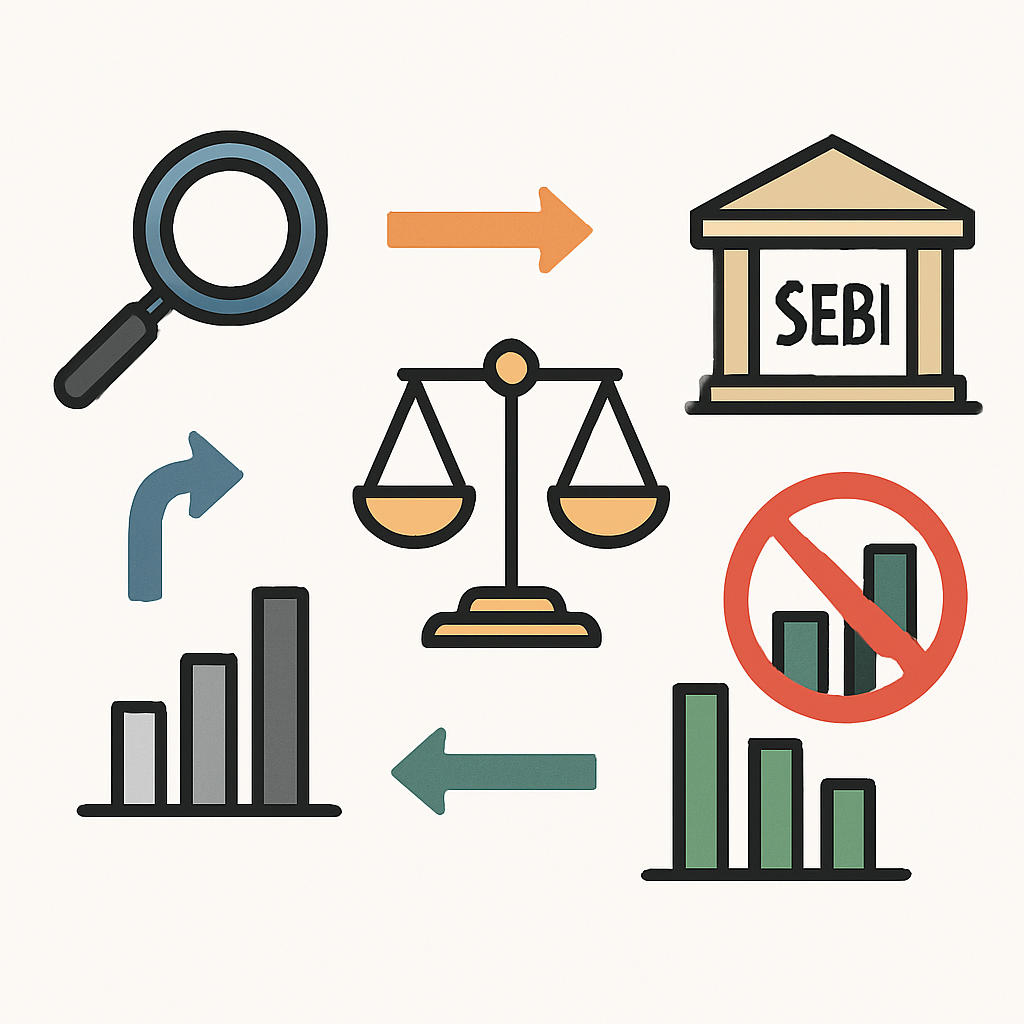
For most long-term retail investors, the direct impact of this case may be limited unless they are actively trading derivatives or concentrated index-linked positions. If your investments are spread through diversified mutual funds, SIPs, retirement products, or long-term equity holdings, one enforcement action does not automatically require a change in your plan. If you are unsure whether your portfolio is exposed to short-term trading risks, consult a financial advisor before making major decisions.
Short-term traders may see sharper movement in options and futures as positions adjust to regulatory action and changing liquidity. Portfolio values can also move temporarily if related index stocks react to the news or if sentiment weakens in derivatives-heavy segments. The key point for everyday investors is to separate temporary market noise from long-term financial goals and seek professional guidance when decisions involve risk, leverage, or complex products.
How Portfolio Values Might Be Affected
Markets work best when prices reflect real demand, supply, earnings, inflation, interest rate expectations, and business fundamentals. If any activity had pushed prices away from fair levels, a correction can occur when that activity stops or comes under regulatory scrutiny. Such corrections may feel uncomfortable, but they can help restore healthier price discovery over time.
Traders in Bank Nifty, Nifty options, and leveraged products may experience more visible volatility because these instruments react quickly to news, liquidity, and positioning. Long-term investors in diversified equity funds may see only temporary mark-to-market changes, depending on how broad the impact becomes. If you want wider context on market flows, read PocketPlanGuru’s guide on why smart investors watch FPIs return to IT stocks.
What Retail Investors Should Watch For
Retail investors cannot investigate market activity like a regulator, but they can learn to spot situations that deserve caution. Unusual price moves, sudden volume spikes, and sharp reversals without clear news can be warning signs, especially in thinly traded stocks or illiquid options. These signs do not prove manipulation, but they are a reminder to verify information before acting on social media trends or trading tips.
A sensible investing process should consider goals, risk capacity, time horizon, and product suitability rather than excitement around a fast-moving trade. Money needed for near-term goals, loan repayments, emergency expenses, or tax obligations should be treated carefully before being exposed to high market risk. If a product or trade is difficult to understand, consult a financial advisor before committing money.
Long-Term Implications for Market Integrity and Trust
SEBI’s action against Jane Street sends a strong message that size, speed, and technology do not place any participant above market rules. The case is especially important because India’s derivatives market has grown rapidly and attracts both institutional players and retail traders. FTI Consulting noted that India accounted for 61% of worldwide equity options contracts by April 2025, which makes strong supervision even more important.
Visible enforcement can strengthen trust in NSE, BSE, and India’s wider capital market ecosystem. When investors believe that regulators are watching large and sophisticated participants, they may feel more confident about fair participation. Trust is essential because capital markets rely not only on liquidity and innovation, but also on the belief that prices are formed honestly.
How SEBI’s Actions Can Restore Confidence
Market confidence improves when investors see accountability for powerful players. If a large trading firm faces market restrictions and an asset freeze linked to alleged unlawful gains, smaller investors may feel that rules apply more evenly. This sense of fairness can support patient participation in equities, mutual funds, and retirement-linked investing.
Regulatory action also reduces the fear that ordinary investors are operating in a market tilted permanently against them. Investors already face uncertainty from inflation, RBI policy, global oil prices, currency movements, and earnings cycles. You can explore related household budget risks in PocketPlanGuru’s article on why rising crude prices matter for your budget now.
Broader Effects on the Indian Capital Market Ecosystem
Stronger action against suspected manipulation can push brokers, exchanges, and proprietary trading desks to improve internal controls. It can also encourage better audit trails, surveillance systems, and risk checks for fast-moving algorithmic strategies. Over time, these improvements may support deeper participation from both domestic and foreign investors.
India’s capital market needs both innovation and trust to grow in a healthy way. Algorithmic trading can improve liquidity and reduce spreads when used responsibly, but misuse can damage confidence quickly. SEBI’s challenge is to allow useful technology while stopping strategies that distort prices or exploit weaker participants.
Recognizing Market Manipulation: A Guide for Indian Investors
Market manipulation can take many forms, including artificial price movements, misleading order activity, or coordinated trading designed to influence sentiment. An overview from IIFL Capital on stock market manipulation explains that identifying manipulation can be difficult because many factors affect security prices. This is why investors should treat warning signs as reasons for caution, not as proof of wrongdoing.
Retail investors should compare price moves with company announcements, sector performance, broad indices, and reliable news sources. If a stock rises sharply while its sector and the wider market are weak, it is reasonable to check whether there is a genuine trigger. Exchange alerts, corporate filings, SEBI orders, and credible financial news are safer sources than unverified chat groups.
Common Signs of Market Manipulation
Unnatural volume surges without business updates can be a red flag, especially in small-cap stocks or illiquid contracts. Price moves that reverse sharply within minutes may reflect aggressive short-term positioning or weak liquidity. Order book anomalies, repeated cancellations, or fake-looking bids may also suggest behaviour that deserves caution.
None of these signals proves wrongdoing on its own because markets can move for many valid reasons. Earnings surprises, tax changes, RBI policy signals, global cues, and institutional flows can all cause sudden price changes. If the price action looks too good to be true or the explanation is unclear, consult a financial advisor before taking a position.
Using SEBI Resources to Stay Informed
SEBI publishes circulars, orders, investor alerts, and consultation papers that can help investors understand regulatory developments. Investors can also check notices and investor resources from NSE India and BSE before reacting to rumours. Reliable sources reduce the chance of falling for pump-and-dump schemes, fake tips, or misleading claims about guaranteed profits.
SEBI’s investor education work also helps people understand fraud risks, grievance options, and safer investing habits. For overseas Indians, digital access and onboarding can make compliance smoother and reduce friction in regulated investing. PocketPlanGuru has covered this topic in what SEBI’s proven digital onboarding means for NRIs.
Safeguarding Your Investments After the Ban
The best response to a market integrity case is not panic, but a clearer review of risk and product suitability. Investors should understand what they own, why they own it, and how each product fits their time horizon. If that review feels difficult or involves derivatives, leverage, concentrated bets, or short-term trading, consult a financial advisor.
Regulated products, transparent disclosures, and documented transactions can make investing easier to monitor. Complex products such as options and futures carry risks that may not be obvious from headline returns or social media discussions. Before using such products, investors should read risk disclosures carefully and seek professional guidance based on their personal financial situation.
Smart Practices in a Regulated Market
Investment decisions should not depend only on daily price moves, trading tips, or sudden online excitement. Company fundamentals, earnings quality, debt levels, governance, fund mandates, costs, and risk levels all deserve attention. If you are unsure how to assess these factors, consult a financial advisor rather than relying on unverified opinions.
Tax planning should also remain separate from speculative market activity. Products linked to Section 80C, such as EPF, PPF, and eligible life insurance premiums, serve different purposes from short-term trading. Filing your ITR correctly and maintaining clear records can help keep your financial plan organised even when markets are volatile.
Using Investor Protection Mechanisms
If you notice suspicious trading activity in your account or in a security you are tracking, preserve relevant records before filing a complaint. Useful records may include order details, screenshots, contract notes, timestamps, broker communications, and transaction references. Clear documentation makes it easier for your broker, exchange, or regulator to review the concern.
Investors can use broker complaint channels, exchange investor support systems, and SEBI’s grievance mechanisms for escalation. It is better to report concerns through official routes than to post unverified allegations online. Public claims without evidence can create confusion and may expose investors to avoidable legal or reputational risk.
The Future of Algorithmic Trading in India
SEBI’s action against Jane Street may push India toward stronger oversight of algorithmic strategies and high-frequency trading. Regulators may focus more on reporting standards, audit trails, risk limits, and real-time monitoring of abnormal order patterns. Exchanges may also strengthen surveillance around index-linked trades, especially where cash, futures, and options activity appear connected.
This does not mean algorithmic trading will disappear from India. Responsible algorithms can improve liquidity, narrow spreads, and help large participants execute trades more efficiently. The policy goal is to separate useful technology from strategies that create artificial moves or undermine trust.
SEBI’s Regulatory Roadmap for Algo Trading
Future rules may require firms to maintain better logs, controls, approvals, and audit trails for algorithmic strategies. SEBI and exchanges can also use stronger surveillance tools to detect repeated suspicious patterns across products and trading venues. Tougher penalties and faster interim measures may deter abusive strategies before they cause wider damage.
Better oversight can also help responsible trading firms compete fairly. When every participant operates under clear rules, technology becomes a tool for efficiency rather than an advantage used to distort markets. This balance is vital for India because market growth without trust can become fragile.
What Investors Should Expect Going Forward
Investors may see more regulatory attention on derivatives, algorithmic orders, and market conduct after this case. Volatility will not disappear because interest rates, inflation, earnings, global news, and liquidity will continue to influence prices. However, stronger enforcement can make investors more confident that suspicious behaviour will be investigated.
Retail traders should understand that trading against sophisticated systems can involve speed, information, and execution disadvantages. Long-term investors should keep their focus on goals, diversification, suitability, and disciplined decision-making. When uncertainty is high or a product is complex, consult a financial advisor instead of reacting emotionally.
Frequently Asked Questions
This FAQ section answers common questions Indian investors may have after SEBI’s action against Jane Street. The answers are meant to be practical and easy to understand. They should support your thinking, but they are not a substitute for personalised advice from a financial advisor.
What exactly caused SEBI to ban Jane Street?
SEBI accused Jane Street of repeated market manipulation through algorithmic trades in Indian derivatives. The regulator alleged that certain trades distorted index prices and helped the firm profit from related options positions. SEBI also froze ₹4,843 crore of assets linked to alleged unlawful gains while the matter drew wider attention to high-frequency trading oversight.
Will this ban affect my stock portfolio directly?
Your portfolio may not face a direct impact if it is diversified and not heavily exposed to short-term derivatives trades. Some temporary volatility can appear in affected index-linked names or related market segments. If you are unsure about your exposure, consult a financial advisor before making changes.
How can I identify possible market manipulation as a retail investor?
You can watch for abnormal price moves, sudden volume jumps, sharp reversals, and activity that does not match available news. Compare the move with sector trends, Nifty, Sensex, company announcements, and exchange alerts. These signs do not prove wrongdoing, but they can help you pause and verify before acting.
What should I do if I notice suspicious trading activity?
Save order details, screenshots, contract notes, timestamps, and broker communications before raising a complaint. Use your broker’s complaint process, exchange investor support channels, or SEBI’s grievance mechanism to report concerns. Avoid posting unverified claims online because that can create confusion and may not help the investigation.
Is algorithmic trading unsafe for Indian investors?
Algorithmic trading is not unsafe by default because it can support liquidity and efficient execution when used properly. The risk comes from weak controls, abusive strategies, or patterns that distort price discovery. If you are considering products affected by algorithmic trading or derivatives activity, consult a financial advisor first.
Stay Alert, Stay Invested, and Keep Learning
SEBI’s action against Jane Street reminds investors that trust is the real backbone of Indian markets. Rules, surveillance, and penalties matter because modern trading can become too complex for ordinary investors to monitor on their own. A calmer approach, reliable information, and professional guidance can help investors avoid emotional decisions during noisy market phases.
For Indian investors, the practical lesson is to respect risk, verify information, and understand products before investing or trading. Market integrity cases may create short-term concern, but strong enforcement can support healthier markets over time. Subscribe to PocketPlanGuru for simple finance explainers on investing, tax, markets, loans, and everyday money decisions.
Disclaimer: The information above is for educational purposes only and does not constitute financial advice.
5 Comments