

Why Crude Prices Matter for Indian Households and Investors
Rising crude oil prices can affect Indian households through fuel bills, grocery prices, transport costs, and inflation. They can also influence SIP returns, stock market sentiment, bond yields, and loan planning. For a country that imports more than 80 percent of its crude oil requirement, global oil shocks can quickly become a household budgeting issue.
Crude prices matter because fuel is linked to many daily costs. Petrol affects commuting, diesel affects goods movement, and LPG affects cooking expenses. When these costs rise together, families may need to review spending, savings, insurance, and investment plans with more care.
How Rising Crude Prices Affect Indian Household Budgets
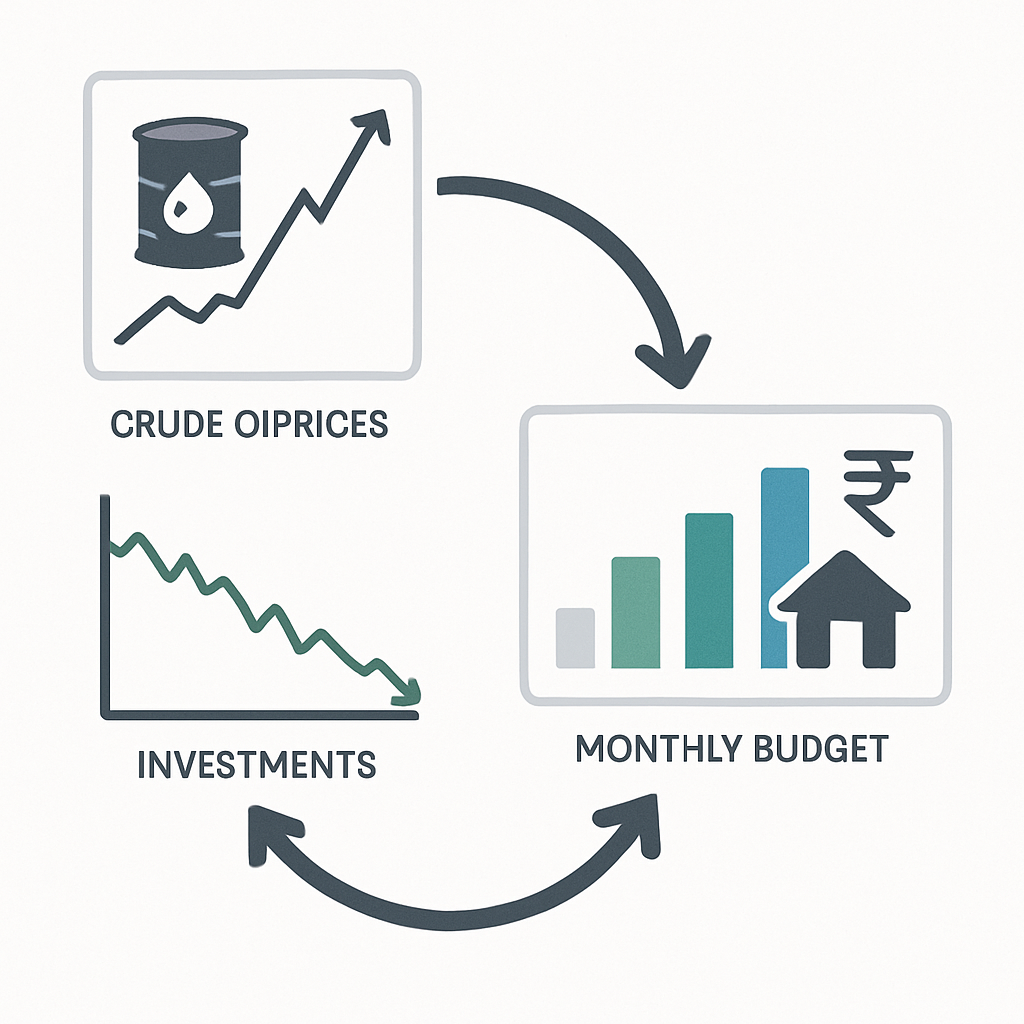
Crude prices directly influence petrol, diesel, and LPG costs in India. When oil becomes costlier, transport and delivery expenses can also rise. This means a middle-class family may feel pressure in daily travel, groceries, school transport, and cooking gas.
Higher fuel costs can reduce money available for non-essential spending. Families may delay purchases, reduce eating out, or use credit cards more often to manage monthly expenses. If this pattern continues, household debt and personal loan dependence can increase.
Impact on Petrol, Diesel, and Cooking Gas Prices
Rising international crude prices often translate into higher fuel costs at Indian pumps. Central excise duty and state VAT form a large part of petrol and diesel prices. This tax structure means final retail prices may not always fall quickly when crude prices cool.
LPG prices affect both urban and rural households. Subsidies can cushion part of the increase for eligible households under government schemes. Even then, the monthly cooking fuel bill can vary by state, distributor, and subsidy eligibility.
A higher petrol bill affects salaried workers, gig workers, students, and small business owners. Diesel also drives goods transport across mandis, warehouses, and retail stores. As transport becomes costlier, everyday items can become more expensive for consumers.
Effect on Food, Transportation, and Power Bills
Fuel inflation often enters the food chain through farming, storage, and delivery costs. Tractors, cold storage units, trucks, and local vans depend on fuel or power. As a result, vegetables, milk, grains, and packaged goods can face price pressure.
Public and private transport fares may also rise during long crude price spikes. Auto, taxi, bus, and logistics operators may try to protect margins when fuel becomes expensive. This can disturb a monthly budget that already includes rent, EMIs, school fees, and insurance premiums.
Power bills can also come under pressure when generation and distribution costs rise. India has expanded renewable energy, but fuel-linked power costs still matter in many regions. If electricity tariffs rise, households may need to adjust appliance use and discretionary spending.
Macroeconomic Implications of Crude Price Surges in India
Oil shocks can hurt growth because they raise inflation and reduce spending power. The Budget Lab’s research on oil market turmoil explains that higher oil prices can reduce consumption and affect investment. India faces this pressure more sharply than oil-exporting economies because it depends heavily on imported crude.
When inflation rises, consumers often spend less on discretionary items. Businesses can also face higher input costs and weaker demand at the same time. This mix can slow growth, even when some energy-linked companies benefit from higher prices.
Inflation and RBI Interest Rate Policy Response
Crude-driven inflation can put the RBI in a difficult position. If prices rise too fast, the central bank may keep a close watch on inflation, liquidity, and the repo rate path. Official policy updates can be tracked through the Reserve Bank of India website.
Higher inflation reduces real income because the same amount of money buys fewer goods and services. It can also affect borrowers through home loan, vehicle loan, and personal loan rates. If rates remain elevated, EMI pressure may reduce savings and investment capacity.
The RBI tries to control inflation without damaging growth more than necessary. This balance matters for equity markets, fixed income, bank deposits, and household financial planning. Before making portfolio changes during such phases, investors should consult a financial advisor.
Effect on Indian Business Investments and Growth
Energy-intensive industries face higher operating costs when crude rises. Airlines, paints, chemicals, cement, transport, and logistics companies can see pressure on margins. The Penn Wharton Budget Model notes that oil prices can become a key driver of business investment.
Volatile crude prices can also make companies delay capital expenditure. The World Bank explains that oil price volatility can reduce planning horizons and make firms postpone investments. For India, this can affect hiring, capacity expansion, and earnings expectations.
Some companies respond by improving energy efficiency and strengthening supply chains. Others may shift toward renewables, electric mobility, or alternative energy sources over time. These changes can create opportunities, but investors should consult a financial advisor before acting on sector themes.
Government Measures That Can Moderate Crude Price Impact
The Indian government uses taxes, subsidies, and policy tools to manage oil shocks. Fuel tax structures vary by state, so pump prices can differ across cities. This is why petrol or diesel may cost more in one location than another on the same day.
Government action can soften the impact, but it cannot remove global price risk fully. Crude is traded globally, and geopolitical tensions can move prices quickly. Household budgets should allow for some fuel-price volatility rather than depend on perfect price stability.
Fuel Taxation and Price Stabilisation
Central excise and state VAT influence what consumers pay for petrol and diesel. Governments may adjust these taxes to cushion price spikes or protect revenue. Consumers feel the final pump price directly because fuel is a frequent and essential expense.
For investors, fuel taxes can also affect oil marketing companies and broader market sentiment. Sudden tax changes may influence margins, earnings expectations, and sector valuations. Listed sector movements can be tracked through the NSE and BSE platforms.
Tax planning also matters at the household level when inflation rises. Families may need to review savings, insurance premiums, loan commitments, and tax-saving products together. Any tax or investment decision should fit long-term goals, not only the ITR deadline.
LPG Subsidies and Alternate Energy Initiatives
LPG subsidy reforms help keep cooking fuel accessible for eligible households. PM Ujjwala Yojana has improved LPG access for many families, with subsidy support where applicable. However, subsidies may not fully offset every global crude or gas-linked price increase.
India’s renewable energy push can reduce long-term dependence on imported fuel. Solar power, electric vehicles, and cleaner cooking options may reduce fuel vulnerability over time. These shifts can also create market interest in power, batteries, infrastructure, and related sectors.
Policy-linked sectors can move sharply after announcements or regulatory changes. Investors should read disclosures and avoid buying only because a theme sounds attractive. A SEBI-registered advisor can help assess risk, valuation, and portfolio suitability.
Impact on Indian Financial Markets During Crude-Induced Volatility
Rising crude prices can affect Indian stocks through inflation, margins, currency pressure, and foreign investor sentiment. Nifty and Sensex often react when oil prices spike suddenly. Market moves may look worrying, but panic selling can lock in losses.
Energy stocks, transport stocks, consumer companies, and banks can react in different ways. According to Holland Capital Group’s note on oil and portfolios, upstream energy firms may benefit while transport and consumer discretionary firms can face pressure. Indian investors should apply this logic carefully to NSE-listed sectors and consult a financial advisor before making changes.
Correlation Between Crude Prices and Indian Equity Markets
Oil and gas companies form a visible part of Indian market indices. When crude rises, upstream producers may benefit, while refiners and marketing companies can face complex margin effects. The final impact depends on taxes, subsidies, pricing policy, demand, and global supply conditions.
Rising crude can also signal inflation risk for investors. That can hurt market mood because investors may fear tighter monetary policy and weaker consumption. Foreign investors may also reassess India when oil increases pressure on the current account.
Retail investors should avoid treating one crude-price move as a complete market forecast. A good portfolio should not depend on one sector, one theme, or one macro event. If you track foreign flows, read our piece on why smart investors watch FPIs return to IT stocks for a broader view.
Market Volatility and Retail Investor Behaviour
Short-term volatility can tempt investors to churn portfolios. This often leads to selling at lows and re-entering at higher levels. SIP investors should review goals and risk tolerance, but they need not stop investments only because daily markets are noisy.
Fixed income can also face challenges during inflationary phases. Bond prices may move when interest rate expectations change. If you hold debt funds or gilts, read our explainer on why long-dated G-Secs matter for fixed income investors.
Staying invested can help reduce the damage from volatility over time. This does not mean ignoring risk, asset allocation, or liquidity needs. It means major changes should be made with a plan and, where needed, after consulting a financial advisor.
Investment Planning During Crude Price Spikes
Crude price spikes should push investors to review risk rather than chase quick tips. A diversified portfolio can handle shocks better than a concentrated one. Your age, income, goals, loans, emergency fund, and risk appetite should guide every investment decision.
Mutual funds, SIPs, EPF, PPF, NPS, gold, and fixed income products play different roles. No single asset protects against every oil shock or every market cycle. Before changing allocation or adding complex products, consult a financial advisor.
Diversification to Manage Oil Price Risk
Some sectors are less directly exposed to crude than others. IT, pharma, and select consumer companies may show more resilience, although valuations still matter. Energy, aviation, logistics, and paints can be more sensitive to oil-price movements.
Mutual funds and ETFs can spread exposure across sectors and companies. This can help investors avoid betting too heavily on one company or theme. SEBI’s investor education resources and alerts on SEBI’s official website can help investors understand risks better.
International diversification may help some investors manage country-specific risks. It can add currency and geography exposure, but it also brings tax, reporting, and market risks. Before investing abroad, review suitability with a financial advisor and understand income tax implications.
Gold, Fixed Income, and Commodity Exposure
Gold often attracts attention during inflation and geopolitical stress. It may not rise every time crude rises, but it can diversify a portfolio. For more context, read our article on why smart investors watch gold’s seven-week surge.
High-quality fixed income can support stability in a volatile portfolio. Returns still depend on interest rates, credit quality, costs, liquidity, and tax treatment. Investors should compare products carefully and consult a financial advisor before making allocation changes.
Commodity funds can provide exposure to crude or broader commodity trends. These products can be volatile and may not suit every investor. They should be evaluated through risk tolerance, time horizon, costs, and professional advice.
Energy Stocks and Policy-Linked Opportunities
Energy stocks can move sharply during oil price spikes. Producers, refiners, gas companies, oilfield services, and power firms do not react in the same way. Policy changes can also shift winners and losers quickly.
Green energy and electric mobility themes may benefit from long-term policy support. However, attractive themes can become risky if investors overpay or ignore fundamentals. Balance sheets, cash flows, debt levels, and regulatory risks should be reviewed before investing.
Retail investors should avoid tips from social media groups and unverified channels. Company filings, exchange updates, and SEBI-registered research sources are more reliable starting points. If the risk is unclear, consult a financial advisor rather than making rushed trades.
Practical Tips to Manage Your Monthly Budget Amid Rising Fuel Costs
A budget can absorb fuel inflation better when households act early. Start by tracking petrol, LPG, electricity, groceries, and transport for two months. Many families discover small leaks in food delivery, subscriptions, impulse purchases, and avoidable travel.
Discretionary travel can be reduced when fuel prices rise sharply. Public transport, metro services, office shuttles, and carpooling may help where available. These small changes can protect SIPs, emergency savings, and insurance payments from monthly strain.
Reducing Household Fuel and Electricity Expenses
Use LPG cylinders carefully and check subsidy eligibility through official channels. Simple steps like pressure cooking, covered vessels, and planned cooking can reduce gas use. Avoiding repeated reheating and poor kitchen planning can also lower fuel waste.
Electricity savings can ease pressure when inflation rises. LED lights, energy-efficient fans, serviced ACs, and sensible appliance use can reduce bills. If your state offers time-of-day tariffs, shift heavy use to lower-cost hours where practical.
Vehicle habits also matter for monthly savings. Maintain tyre pressure, avoid harsh braking, and combine errands into fewer trips. These actions may look small, but they can build meaningful savings over a full year.
Planning for Inflation-Driven Cost Increases
Build a simple monthly budget with fixed, variable, and goal-based expenses. Keep rent, EMIs, insurance, school fees, groceries, and transport visible in one place. A spreadsheet or budgeting app can help you spot stress before it becomes serious.
Grocery planning can also reduce inflation pressure. Shift toward seasonal and local produce, compare unit prices, and reduce waste. A planned shopping list can be more useful than buying items only because they are on discount.
An emergency fund can protect households from sudden fuel, medical, or job shocks. Loan commitments, term insurance, health cover, and recurring investments should be reviewed together. If you are unsure how to balance these priorities, consult a qualified financial advisor.
FAQ: Crude Prices, Investments, and Budgeting in India
These common questions connect crude prices with everyday money decisions. The answers focus on practical steps for Indian households and retail investors. Treat them as a starting point and consult a financial advisor for personalised guidance.
How do rising crude prices affect fuel rates in India?
Higher international crude prices raise the base cost of petrol, diesel, and LPG. Indian taxes, dealer margins, and local levies then shape the final retail price. This is why global oil shocks can quickly affect commuting, cooking, and goods transport.
Which sectors can be affected most by oil price spikes?
Transport, aviation, logistics, paints, chemicals, and some consumer businesses can face cost pressure when oil rises. Energy producers may benefit in some phases, but their performance can still be volatile. Sector exposure should be reviewed with a financial advisor before investing.
How can I protect my investments from crude price volatility?
Diversification across equity sectors, fixed income, gold, and suitable long-term products can reduce dependence on one risk factor. SIPs may continue if they match your goals, time horizon, and risk profile. Major allocation changes should be discussed with a financial advisor.
Do government subsidies fully offset rising LPG costs?
Subsidies can cushion LPG costs for eligible households and schemes. They may not fully cover every global price increase or every consumer category. Households should check subsidy status and plan cooking fuel expenses in the monthly budget.
What steps can reduce the monthly impact of fuel inflation?
Use public transport, carpool, reduce avoidable trips, and improve vehicle efficiency where possible. Save electricity with LED lights, efficient appliances, and careful AC use. Track expenses monthly so rising fuel costs do not disturb savings goals.
Rising crude prices and market turmoil can test household budgets and investor patience. Preparation is more useful than panic when fuel, inflation, and markets move together. Review your budget, loans, insurance, emergency fund, SIPs, and asset allocation, and consult a financial advisor before making major financial decisions.
Disclaimer: The information above is for educational purposes only and does not constitute financial advice.
7 Comments