

The Stark Reality: 88% of Retail F&O Traders Lost Money in FY26
Recent market reports citing SEBI-linked findings show that 88% of individual retail traders lost money in F&O during FY26. According to the Economic Times report on retail F&O losses, individual traders posted aggregate net losses of about Rs 91,685 crore. This is a serious personal finance warning for households that may also need money for emergency funds, insurance, retirement planning, education goals, or long-term investments.
The main message is simple: frequent trading can turn small errors into large losses. Every trade carries costs such as brokerage, exchange charges, Securities Transaction Tax, GST, stamp duty, spreads, slippage, and tax impact. When retail F&O traders lose money repeatedly, these costs often play a bigger role than traders first realise.
SEBI Findings and Market Context
Reports discussing SEBI’s earlier studies show that the problem is not new. A LinkedIn post summarising SEBI’s retail F&O findings notes that around 89% of individual F&O traders lost money in FY23. The FY26 figure of 88% suggests that tighter rules and lower participation have not meaningfully changed the risk for many active retail traders.
Options trading accounted for most aggregate net losses, based on the cited market reports. Many traders enter weekly options because premiums look small and the fast movement feels exciting. Small premiums can still hide large practical risk when positions are repeated without discipline, capital protection, and a clear understanding of costs.
How Trading Frequency Drives Losses
The underreported lesson is that frequency itself can predict losses. The same SEBI-linked discussion notes that the traders who lost the most were often not the ones who made one bad call. They were the ones who made too many calls and confused movement with progress.
High-frequency retail activity increases brokerage, STT, tax burden, slippage, and emotional fatigue. A trader may earn on a few trades but still lose net money after costs are included. This is why retail F&O traders can lose money even when they feel they are active, informed, and learning daily.
Behavioral Finance: Why Retail Traders Repeat Costly Mistakes
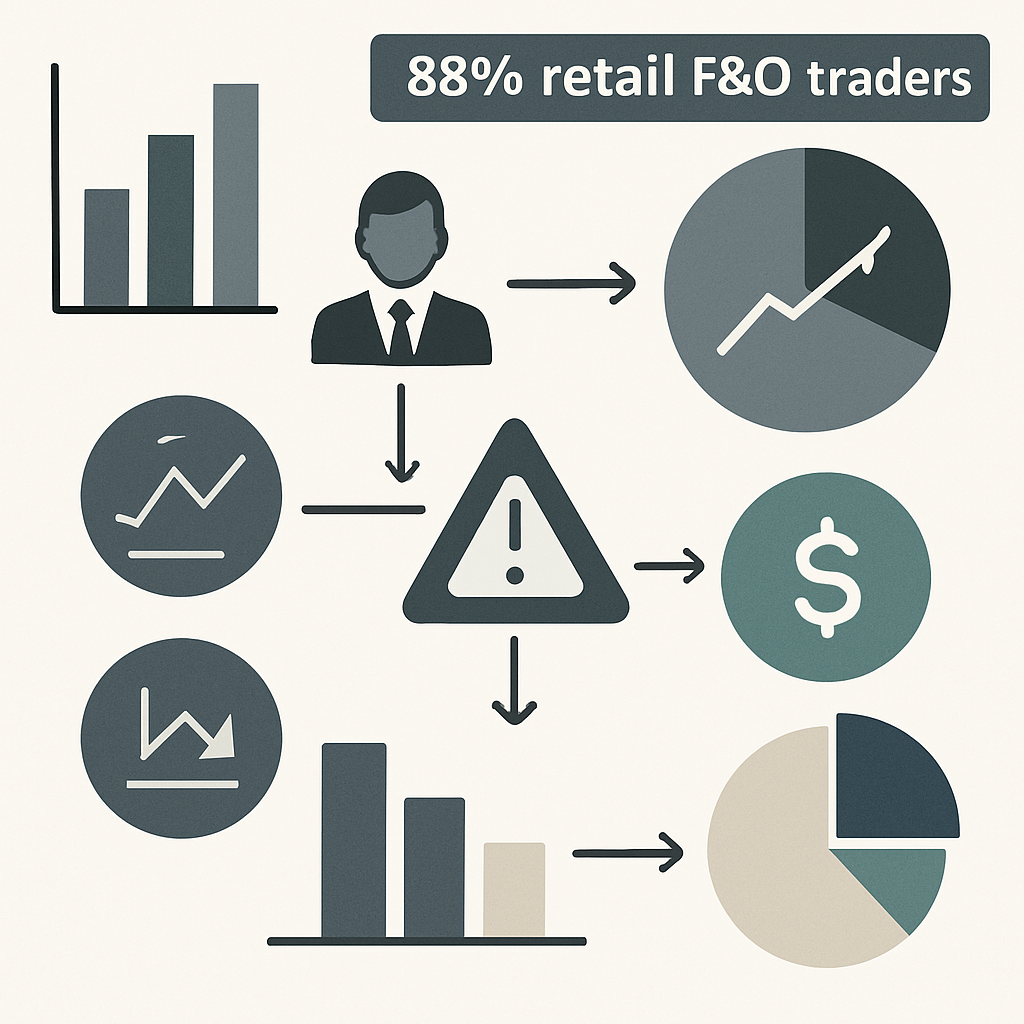
F&O trading is not only a market problem; it is also a behaviour problem. Overconfidence makes traders believe they can predict every Nifty or Bank Nifty move after watching a few chart patterns. Loss aversion then makes them hold losing trades too long and book winning trades too early.
Herd mentality adds another trap. If a Telegram group, YouTube stream, or social media post says the market may rally, many traders jump in without checking whether the trade suits their risk capacity. For a wider view on why market rules and conduct matter, read PocketPlanGuru’s guide on Why SEBI’s Ban on Market Manipulators Matters for Your Investments.
Common Cognitive Biases Affecting Indian F&O Traders
Overconfidence is one of the most common biases among new traders. A few profitable trades can make someone believe they have special skill, even when luck or a strong market trend played a major role. The next step is often larger lots, tighter stop losses, and higher stress.
Anchoring also hurts traders. Many anchor to yesterday’s closing price, a recent news headline, or a one-day profit. Emotions then override the trading plan, especially when losses start affecting credit card bills, loan EMIs, or household cash flow.
Strategies to Overcome Behavioral Pitfalls
A written framework can help traders slow down before placing orders. This may include defining risk limits, documenting reasons for entry and exit, and reviewing whether F&O is suitable for the person’s financial situation. Anyone unsure about risk capacity should consult a financial advisor before risking more capital.
A trading journal can also reveal patterns that are difficult to see in real time. It can show whether losses came from poor entries, oversized positions, repeated revenge trading, or simply too many trades. If the journal shows repeated emotional behaviour, stepping back from F&O may be wiser than trying to recover losses quickly.
Navigating Market Realities: Algo and High-Frequency Trading Impact
Retail traders do not compete only with other retail traders. They also face institutional desks, algorithms, and high-frequency systems that react faster than humans. These systems can change quotes within milliseconds, especially in liquid index and stock options.
This does not mean every retail loss comes from algo trading. It means short-term trading has a structural speed disadvantage for the average person using a mobile app. When retail F&O traders lose money in such a setup, the issue may be market structure, behaviour, costs, and risk control rather than skill alone.
How Algo Trading Changes the Retail Experience
High-frequency traders use advanced data, co-location, and automated systems. They can react to order flow and price changes much faster than a normal trader watching a screen. Rapid quote changes can create poor entries and exits during volatile minutes.
Expiry-day volatility can be especially painful for small traders. Weekly options attract many participants because the ticket size appears low compared with buying shares. Fast moves can still wipe out premiums before a trader fully understands what changed.
How Retail Traders Can Reduce Structural Disadvantages
Retail traders may reduce this disadvantage by avoiding a race against faster systems. A slower, rule-based approach can reduce impulsive trades and help traders avoid reacting to every tick. Before using derivatives actively, investors should consult a financial advisor to understand whether the product is suitable for their goals and risk profile.
Mobile notifications can turn investing into a casino-like habit. Alerts may be useful for monitoring, but too many alerts can push people into unnecessary activity. If you track broader market flows, PocketPlanGuru’s article on Why Smart Investors Watch FPIs Return to IT Stocks can help you think beyond one-minute candles.
Cost Control: Brokerage, Taxes and Hidden Charges
Costs are boring, but they decide real returns. A trader may focus on a Rs 2,000 gross profit and ignore several layers of charges. Over hundreds of trades, these small costs can become a large drag on net performance.
Indian traders must understand brokerage, STT, exchange charges, GST, stamp duty, spreads, slippage, and income tax treatment. F&O income is commonly treated differently from simple long-term investing, and the correct tax treatment depends on facts and rules applicable to the person. Traders should consult a tax professional or financial advisor before filing returns or changing their trading structure.
Breakdown of Common F&O Trading Costs in India
Brokerage can vary by broker and plan. Some brokers charge flat fees per order, while others may charge differently depending on product type or account structure. Even a low-cost broker cannot remove statutory charges like STT, GST, exchange charges, and stamp duty.
STT applies on securities transactions and can reduce net gains. Exchange charges, spreads, and stamp duty also add up when trades are frequent. Investors can check investor education material on the NSE website on charges and taxes before placing trades.
Why Lower Costs Do Not Fix a Weak Strategy
A cheaper broker may reduce the cost per trade, but it cannot turn an unsuitable strategy into a suitable one. If a trader enters too often, exits emotionally, or uses oversized positions, lower brokerage only slows the damage. The first question should be whether the trade is necessary, not whether the order is cheap.
Cost awareness should be part of a broader financial plan. Traders need to track net profit after all charges, taxes, and losses, not only successful trades shown on a dashboard. If the goal is long-term wealth creation, it may be useful to compare trading results with simpler alternatives after consulting a financial advisor.
From Frequent Trading to Strategic Investing
The better lesson from the FY26 data is not that every investor must avoid derivatives forever. The better lesson is that derivatives should be treated as complex, high-risk tools rather than shortcuts to income. Many experienced market participants use F&O for hedging, but suitability depends on knowledge, capital, goals, and professional guidance.
Long-term investing usually gives compounding more time to work. A market professional’s post on Indian derivatives trading presents a useful principle: use F&O carefully and avoid treating it as a wealth-creation shortcut. For return expectations, you may also read PocketPlanGuru’s piece on Why Raamdeo Agrawal’s 15% Return Forecast Matters Now.
Building a Balanced Portfolio for Indian Investors
A balanced Indian portfolio may include equity, debt, mutual funds, gold, and fixed-income products based on risk profile. Long-term planning may also involve EPF, PPF, NPS, insurance, and tax-saving instruments depending on personal circumstances. The right mix depends on income, age, goals, dependents, debt, and risk comfort.
Derivatives should not become the centre of a family’s financial plan. Emergency funds, health cover, term insurance, and debt control usually deserve attention before complex products. Investors should consult a financial advisor before changing asset allocation or adding F&O exposure.
How to Reduce Trading Frequency Without Losing Perspective
Reducing trading frequency does not mean ignoring markets. It means separating genuine opportunities from boredom, fear of missing out, and the desire to recover a previous loss. A trader who cannot explain the reason for a trade in writing may be reacting rather than planning.
Long-term investors can often benefit from reviewing portfolios at sensible intervals rather than checking every tick. This works better for diversified equity, mutual funds, and goal-based asset allocation. RBI policy, repo rate changes, inflation trends, earnings, and asset allocation may matter more than intraday noise.
Practical Steps to Recover and Grow After Losses
Losses can feel personal, but a calm review is more useful than blame. Start by writing down major trades, entry reasons, exit reasons, costs, position size, and emotional triggers. This can reveal whether the problem was strategy, frequency, costs, leverage, or discipline.
Trying to recover all losses quickly can be dangerous. That mindset often leads to larger bets and deeper damage. A NiftyTrader analysis of FY25 retail F&O losses also frames large aggregate losses as a warning about behaviour, not just market direction.
Creating a Post-Loss Action Plan
Document losses without bias and avoid blaming only operators, algos, or bad luck. Reduce exposure to high-risk trades until your decision process becomes consistent and calm. Keep enough money outside trading so household goals do not suffer because of market losses.
Stay updated on SEBI rules, NSE circulars, and tax changes. You can use the SEBI website for official updates and investor awareness material. For fixed income balance, PocketPlanGuru’s article on Why Long-Dated G-Secs Are the Best Fixed Income Bet may help you think beyond derivatives.
Using Technology Wisely
Technology should support discipline, not destroy it. Platforms that show risk, margin, profit, loss, and order history clearly can help users understand their own behaviour. Alerts can help with monitoring, but too many alerts can push traders into impulsive decisions.
Switching off non-essential trading notifications may reduce FOMO. Watchlists, order history, and risk dashboards are useful only when they lead to better decisions. The goal is not to trade more, but to make fewer, calmer, and more informed choices.
Frequently Asked QuestionsWhy do most retail F&O traders lose money in India?
Most retail F&O traders lose money because they trade too often, underestimate costs, and take emotional decisions. Brokerage, STT, taxes, spreads, and slippage reduce net gains. Behavioural traps like overconfidence, loss aversion, and revenge trading can make the damage worse.
Can algorithmic trading be countered by retail investors?
Retail investors usually cannot match the speed of high-frequency systems. They can reduce the disadvantage by avoiding unnecessary ultra-short-term activity and by focusing on suitability, discipline, and risk control. Anyone using derivatives should consult a financial advisor to understand whether the product fits their financial situation.
How can I reduce brokerage and transaction cost impact?
You can compare broker charges, understand statutory costs, and reduce unnecessary trades. Consolidating activity can help because every order may add some cost through brokerage, taxes, spreads, or slippage. You should also track tax impact properly and consult a tax professional or financial advisor while filing returns.
Is long-term investing better than frequent F&O trading?
For many Indian households, long-term investing is easier to manage than frequent F&O trading. Diversified mutual funds, SIPs, and goal-based asset allocation can reduce the pressure of daily decisions. They may also help control costs and give compounding more time, but investors should consult a financial advisor for a suitable plan.
What behavioural changes can improve trading discipline?
Written rules, smaller risk exposure, trade journals, and planned exits can improve discipline. Avoid trading when angry, tired, distracted, or desperate to recover losses. If losses continue or decisions feel emotional, stepping back and consulting a financial advisor may be the safest move.
Final Takeaway for Your Investment Strategy
The FY26 data sends a clear message to Indian investors. When 88% of retail F&O traders lose money, trading should be treated as a high-risk activity rather than a shortcut to wealth. The smarter response is to reassess behaviour, understand costs, and consult a financial advisor before taking fresh risk.
Building wealth usually requires staying in the game for years, not winning every expiry. Long-term investing, asset allocation, emergency planning, insurance, and tax awareness can matter more than the next option trade. Your next smart move may be trading less, planning better, and using F&O only when it truly fits your financial plan.
Disclaimer: The information above is for educational purposes only and does not constitute financial advice.
6 Comments