


What Are FCNR(B) Deposits and How Do They Work?
Foreign Currency Non-Resident Bank deposits, or FCNR(B) deposits, are term deposits offered by Indian banks to NRIs and eligible persons of Indian origin. The money is placed in a foreign currency, such as US dollars, and the principal plus interest are repaid in the same currency. This structure helps NRIs avoid the rupee conversion risk that comes with many India-linked savings products.
As reported by The Economic Times on higher FCNR rates, both NRE fixed deposits and FCNR(B) deposits are tax-free in India and fully repatriable for eligible NRIs. The key difference is the currency used for the deposit. An NRE fixed deposit is denominated in rupees, while an FCNR(B) deposit can remain in dollars or another permitted foreign currency.
Features and Benefits of FCNR(B) Deposits
Recent market reports show that some US dollar FCNR(B) rates can reach around 7%, depending on the bank and tenure. This has drawn attention because many NRIs compare these returns with dollar deposits available abroad. The appeal is simple: earn a competitive rate while keeping the money in foreign currency.
The biggest comfort is protection from rupee depreciation. If the rupee weakens during the deposit term, the dollar principal and dollar interest remain payable in dollars. This differs from rupee products, where exchange rate changes can reduce the final dollar return after conversion.
FCNR(B) deposits are generally available for fixed tenures, commonly from one year to five years. Longer tenures may offer attractive rates, but they also reduce flexibility. NRIs should match the deposit term with real goals, such as education fees, home loan repayment, relocation planning, or other dollar expenses, and consult a financial advisor before committing large sums.
Comparison with Other NRI Deposit Types
NRE fixed deposits are rupee-denominated and fully repatriable. They may suit NRIs who plan to spend in India or who are comfortable with rupee exposure. However, dollar-based investors carry currency risk because the final return depends on the rupee-dollar exchange rate.
NRO fixed deposits are usually used for Indian income, such as rent, dividends, pension, or other domestic receipts. Interest on NRO deposits is taxable in India, and repatriation rules can be more restrictive than NRE or FCNR(B) accounts. This makes them less straightforward for NRIs who want simple dollar savings and easy overseas access.
FCNR(B) deposits combine foreign-currency denomination with full repatriation. That makes them different from many India-linked products such as PPF, EPF, NPS, or Section 80C tax-saving investments, which mainly serve resident Indian planning. Product choice should depend on goals, cash flow, risk tolerance, and tax residency, so NRIs should consult a financial advisor before deciding.
Risks Beyond Currency Protection in FCNR(B) Deposits
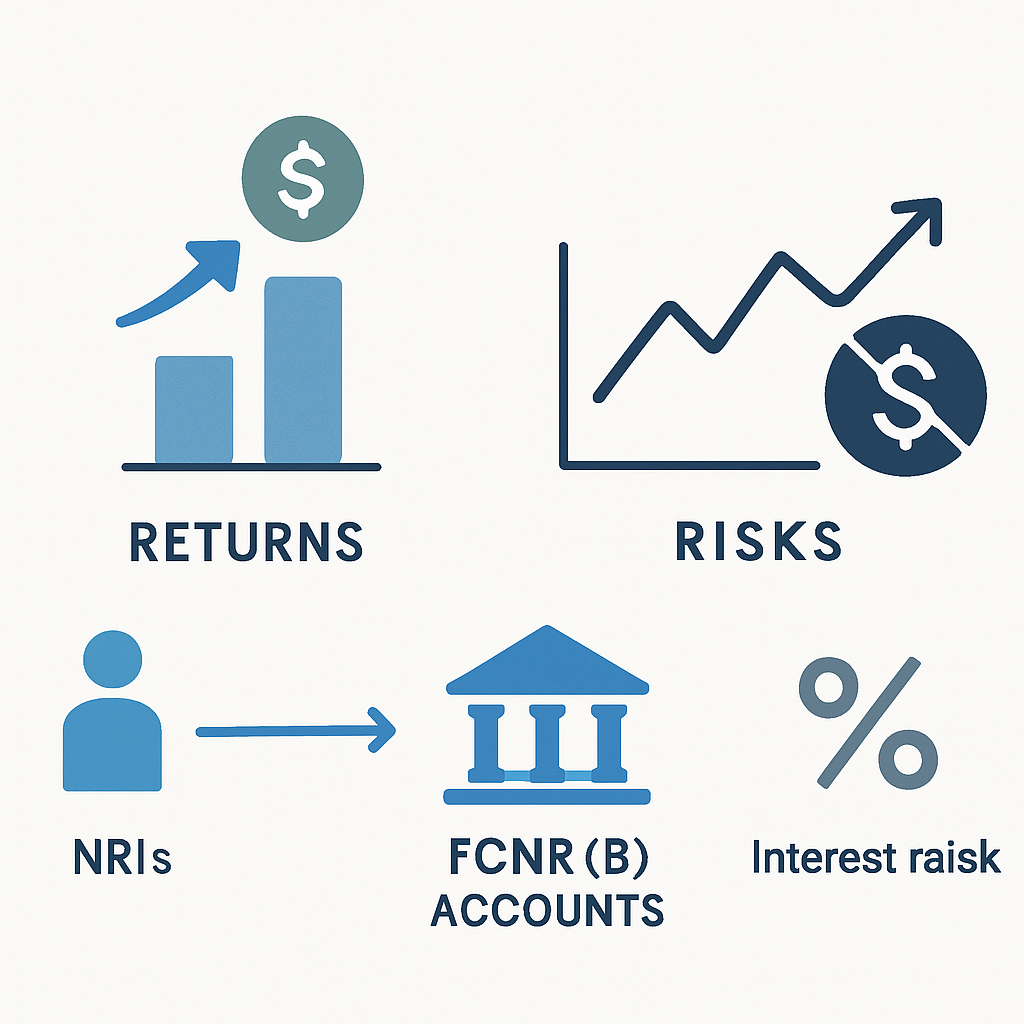
Currency protection does not remove every risk. NRIs still face liquidity limits, bank credit risk, changing regulations, and personal tax reporting duties in their country of residence. A high interest rate should not be the only reason to choose any deposit.
Banking risk also matters because every bank does not carry the same financial strength. Indian investors often study bank earnings, margins, asset quality, and management commentary before buying shares on the NSE or BSE. NRIs can use a similar risk-checking mindset while reading about why private banks’ margin squeeze can be a warning sign.
Liquidity and Lock-in Considerations
FCNR(B) accounts are term deposits, so early withdrawal may come with conditions. Some banks may allow premature withdrawal with penalties, while others may deny interest if the deposit closes too early. The exact rule depends on the bank, deposit tenure, and completed holding period.
Long tenures can become a problem if cash is needed suddenly. A job loss abroad, medical expense, property payment, or child’s university fee can force early access. NRIs should keep emergency money in a more liquid account and consult a financial advisor before locking most of their dollar savings into one term.
Maturity planning also matters for cash flow. If future spending is in dollars, locking all money for the same long period can reduce flexibility. Some savers discuss staggered maturities with a financial advisor, but this should be based on personal goals and not copied from a generic example.
Bank Credit and Macroeconomic Risks
FCNR(B) deposits sit with Indian banks, so the bank’s health matters. A large public or private bank may offer comfort, but NRIs should still review ratings, service record, financial strength, and reputation. Chasing the highest rate without checking safety can create avoidable concentration risk.
Macroeconomic conditions can also affect deposit comfort. Inflation, RBI policy, global interest rates, and dollar funding costs can influence how banks price FCNR(B) deposits. Even if an existing fixed deposit rate is locked, future renewal rates may be very different.
Diversification can reduce dependence on one institution, but it should be planned carefully. Some NRIs may discuss spreading deposits across banks with a financial advisor. This is a risk-control discussion, not a universal recommendation for every investor.
Regulatory and Geopolitical Risks
RBI rules shape how Indian banks offer foreign-currency deposits. Policy changes can affect rates, hedging support, operational rules, or bank-level terms. NRIs should read official bank communication and RBI-linked updates before making large commitments.
Geopolitical stress can influence global dollar funding markets. Oil prices, trade tensions, capital flows, and interest-rate expectations can affect India’s external balances and the rupee. For a wider rupee context, read PocketPlanGuru’s explainer on how a weaker rupee affects household finances.
Markets such as the Nifty and Sensex react quickly to global shocks, while fixed deposits move more slowly. That slow movement can feel safe, but it can hide reinvestment risk. If rates fall by maturity, the next deposit may earn less than the current one.
Tax Implications of FCNR(B) Deposits for NRIs
Interest on FCNR(B) deposits is tax-exempt in India for eligible NRIs. This is one reason the product looks cleaner than NRO deposits from an Indian tax perspective. However, the Indian tax benefit does not automatically settle the tax position in another country.
The country of residence may still tax the interest. The US, UK, Canada, and many other jurisdictions generally tax residents on global income, subject to their own rules and exemptions. NRIs should speak with a qualified tax professional before assuming that tax-free in India means tax-free everywhere.
Taxation in Popular NRI Countries
US tax residents generally report worldwide income, including foreign bank interest. They may also have foreign account reporting duties if account values cross applicable thresholds. NRIs in the US should take cross-border tax advice before opening large deposits.
UK residents may need to report foreign interest income under local tax rules. Canada also taxes worldwide income and may require foreign asset disclosure when thresholds apply. The UAE may look simpler for many individuals, but residency, documentation, source of funds, and banking checks still matter.
Tax rules can change, and informal advice can be incomplete. A friend’s situation may differ because of visa status, residency days, citizenship, income level, or account ownership. For larger deposits, NRIs may need both an Indian chartered accountant and an overseas tax advisor.
Using DTAA Rules Carefully
Double Taxation Avoidance Agreements can help reduce double taxation on the same income. They do not remove the need to report income when the resident country requires disclosure. Documentation and correct filing remain important even when Indian tax is not payable.
NRIs should preserve bank statements, interest certificates, deposit confirmations, and maturity advice. These records can support tax filing and compliance checks. If the same person also holds mutual funds, SIPs, shares, or property in India, all income records should be organised together.
Step-by-Step Guide to Opening and Managing an FCNR(B) Account
Opening an FCNR(B) account usually starts with choosing an authorised Indian bank. Existing NRI customers may be able to open deposits through internet banking or relationship manager support. New customers may need branch assistance, video KYC, couriered documents, or physical forms.
The funding process usually involves transferring dollars or another permitted foreign currency from an overseas bank account. Some banks may also accept funds from an existing NRE or FCNR account, subject to their rules. NRIs should confirm charges, remittance timelines, account details, and currency handling before sending money.
Documentation and Eligibility Criteria
Banks commonly ask for a valid passport, visa or residence permit, and proof of NRI status. They may also request overseas address proof, overseas bank statements, photographs, and PAN details. Requirements differ by bank, so the latest checklist should be collected directly from the institution.
Some banks ask for FATCA and CRS declarations. These forms help banks meet global tax information-sharing rules. Wrong or inconsistent details can delay account opening, reporting, or future servicing.
Eligibility rules can differ for NRIs, PIOs, and OCI cardholders. The bank will verify status before accepting the deposit. If residential status changes later, the account holder should inform the bank promptly and seek tax guidance.
Selecting the Right Bank and Deposit Term
Interest rate comparison is only the starting point. NRIs should also review the bank’s credit profile, service quality, digital access, premature withdrawal rules, and customer support. A slightly lower rate may be acceptable for someone who values stronger comfort and smoother servicing.
Tenure choice matters because the money is locked for a defined period. A longer term may look attractive when rates are high, but personal plans can change. Education, property purchase, retirement, family support, and relocation plans should all be discussed with a financial advisor before choosing a term.
If an NRI also invests in Indian equities, the risk buckets should be separated clearly. A fixed deposit is not the same as a Nifty fund, midcap stock, or IPO. For equity context, read why smart investors track IPO earnings before investing.
Deposit Opening, Renewal, and Record-Keeping
After documentation, the account holder submits the application and funds the deposit in the chosen currency. Online forms may differ from physical forms, especially for new customers. Copies of instructions, confirmations, remittance references, and bank acknowledgements should be retained.
Maturity dates should be tracked well in advance. Reviewing renewal options before maturity gives time to compare rates, liquidity needs, and alternate products. If rates fall or personal goals change, consult a financial advisor before renewing automatically.
Nomination and contact details should not be ignored. Many NRIs change phone numbers, addresses, jobs, or countries over time. Updated records reduce stress for the family if account access becomes urgent.
Comparing FCNR(B) with Other Dollar Investment Options
NRIs often compare FCNR(B) deposits with NRE fixed deposits, US bank deposits, treasury products, certificates of deposit, and overseas money market funds. Each option differs on return, liquidity, tax treatment, risk, and ease of access. A higher rate in India still needs careful review before money is moved.
Moneycontrol’s report on RBI absorbing hedging costs explains that principal and interest in an FCNR(B) deposit remain protected from rupee-dollar exchange movements. That protection can be useful for dollar goals. However, repatriation ease, tax reporting, and banking rules in the country of residence also matter.
FCNR(B) vs NRE Fixed Deposits
NRE fixed deposits pay interest in rupees and work well for India-based spending. They are also tax-free in India and fully repatriable for eligible NRIs. Their weak point for dollar investors is currency risk when rupees are converted back into dollars.
The Economic Times report highlights long-term rupee depreciation as a key concern for NRE fixed deposit investors. A rupee return may look attractive in India, but the dollar result can shrink if the rupee weakens. This is why dollar-focused NRIs often compare NRE and FCNR(B) deposits carefully.
NRE deposits may offer different liquidity rules depending on the bank. Some NRIs may prefer them when expenses are mostly in India. Others may prefer FCNR(B) deposits when the target currency is dollars, but the choice should be made after consulting a financial advisor.
FCNR(B) vs Dollar Investments Abroad
Dollar deposits abroad may offer stronger local access and simpler tax tracking. They may also sit within the banking protection framework of the resident country. For NRIs who spend mainly abroad, convenience can matter as much as yield.
Indian FCNR(B) rates have become competitive compared with many overseas bank deposits. The Indian Express explained the rate gap and leverage angle while discussing recent bank hikes. Higher yield should still be weighed against lock-in, tax reporting, and bank exposure.
Overseas options may include certificates of deposit, treasury bills, or money market funds. These are not identical to Indian bank deposits and can carry their own risks. Product documents, insurance coverage, liquidity rules, and tax treatment should be reviewed before shifting funds.
Leveraging FCNR(B) Accounts: Opportunities and Caveats
Leverage means borrowing money to increase the size of an investment. In the FCNR(B) context, some NRIs borrow dollars abroad and place borrowed funds into Indian deposits. The aim is to earn a spread between the deposit rate and the borrowing cost.
Mint’s report on leveraged FCNR(B) strategies explains how loans linked to benchmarks such as SOFR can be used in such structures. This can magnify gains if the spread remains positive. It can also magnify losses if borrowing costs rise, rules change, or the lender alters terms.
How Leverage Works with FCNR(B) Accounts
An NRI may open a dollar deposit with personal capital and then borrow against it from a foreign bank. The borrowed dollars may be reinvested into another FCNR(B) deposit. This creates a larger deposit base, but it also creates a repayment obligation.
The profit depends on the interest spread after all costs. Loan interest, processing charges, margin requirements, tax effects, and documentation costs can reduce returns. If the spread narrows, the structure can become unattractive quickly.
Some headlines discuss very high leveraged returns. Those numbers depend on borrowing size, stable funding costs, and continued access to credit. They are not normal fixed deposit returns and should not be treated as risk-free income.
Risks and Regulatory Restrictions on Leverage
Leverage adds repayment pressure. If loan rates rise, the investor still owes the lender. A deposit protects against rupee-dollar movement, but it does not protect against every funding shock.
Regulatory changes can also affect the structure. RBI rules may change, banks may alter loan terms, and foreign lenders may reduce limits. Leveraged deposits are suitable only for investors who understand borrowing, margin, tax, and counterparty risks, and even they should consult a financial advisor.
Credit exposure also increases when leverage is used. A simple deposit already carries bank exposure, while leverage increases the amount tied to the strategy. Before considering leverage, NRIs should read loan terms carefully and take professional financial and tax advice.
FAQs on FCNR(B) Deposits for NRIs
NRIs usually ask about withdrawal, tax, exchange rates, documents, and leverage before opening an FCNR(B) account. These questions are sensible because the product looks simple but has several moving parts. The answers below offer general education and should not be treated as personal financial advice.
Can NRIs withdraw an FCNR(B) deposit before maturity?
Premature withdrawal rules vary by bank and tenure. Some banks may charge penalties, while some may not pay interest if the deposit is closed too early. Always check the bank’s written terms and consult a financial advisor if liquidity is a major concern.
Are FCNR(B) deposit interests taxable in India?
For eligible NRIs, FCNR(B) interest is tax-free in India. The country of residence may still tax the interest under global income rules. Keep records and speak with a qualified tax advisor before filing returns.
How do currency fluctuations impact FCNR(B) returns?
The deposit remains in the chosen foreign currency, such as US dollars. Rupee depreciation does not reduce the dollar principal or dollar interest. This is the main difference from an NRE fixed deposit, which is rupee-denominated.
What documents are required to open an FCNR(B) account?
Banks usually ask for a passport, visa or residence proof, overseas address proof, and NRI status details. PAN, overseas bank statements, photographs, FATCA forms, and CRS declarations may also be required. The exact checklist should be confirmed with the selected bank before starting the process.
Is leveraging recommended for FCNR(B) accounts?
Leverage can raise potential returns, but it also raises risk. It involves borrowing costs, margin rules, lender terms, tax effects, and greater bank exposure. Most NRIs should avoid treating it like a normal deposit strategy and should consult a financial advisor before considering it.
Final Takeaway for NRI Dollar Investors
FCNR(B) deposits can be useful for NRIs who want dollar returns, Indian bank access, and protection from rupee swings. The current rate appeal is real, but lock-ins, bank credit risk, tax reporting, and leverage risk deserve equal attention. The right choice depends on goals, liquidity needs, tax residency, and risk comfort.
NRIs should compare FCNR(B) deposits with NRE fixed deposits, overseas dollar deposits, treasury products, and other suitable options. They should also keep documentation clean and review tax obligations in both India and their resident country. Before committing large sums, consult a financial advisor and avoid making decisions based only on headline rates.
Disclaimer: The information above is for educational purposes only and does not constitute financial advice.
4 Comments