


Understanding SEBI’s New Fast-Track Securities Transmission Rules
Transmission of securities means moving investments from a deceased investor’s account to the rightful claimant, nominee, legal heir, or beneficiary. For Indian families, this can involve demat holdings, listed shares, mutual fund units, bonds, exchange-traded funds, and other securities held through brokers, depository participants, registrars, or asset management companies. SEBI’s New Fast-Track Securities Transmission reforms aim to make this process simpler, faster, and less document-heavy for heirs during an already difficult time.
Earlier, families often faced long checklists, repeated affidavits, legal certificates, mismatched records, and different interpretations across institutions. Recent professional updates, including this note on how SEBI simplifies investment transmission for heirs and claimants, highlight the regulator’s focus on easing the burden on investor families. The key message for estate planning is simple: clean records, updated nominations, and clear family documentation can now help heirs complete claims with fewer avoidable delays.
A major relief is that probate of a will is no longer treated as a mandatory SEBI requirement for securities transmission in every case. This matters because probate can be time-consuming and costly, especially where families already agree on the claimant and the investment records are consistent. However, probate, court orders, succession documents, or additional proof may still be relevant if there is a dispute, conflicting documentation, or a specific legal requirement in the facts of the case.
What Has Changed Under SEBI’s New Rules?
SEBI has introduced a Quick Transmission Processing framework, often referred to as QTP, for eligible small-value claims with simplified documentation. Updates shared in this post on SEBI reforms for investor families point to higher documentation thresholds, reduced paperwork, and faster handling where the claimant’s file is complete. Families should still confirm the latest applicable checklist with the depository participant, registrar, broker, or asset management company because operational requirements can vary by holding type and claim situation.
The reform does not mean every claim will be automatic or that legal heirship will never be examined. It means eligible claims should not be delayed by unnecessary paperwork when basic documents, identity proof, death records, nominations, and institutional records are aligned. If the documents do not match, or if more than one person claims the same securities, institutions may ask for additional evidence before completing transmission.
Who Benefits Most from These Reforms?
Small investors and their families are likely to benefit most because many retail portfolios fall within simplified processing categories. Families with listed shares, mutual funds, bonds, and demat investments spread across platforms can also benefit if they maintain one clear record of holdings and nominees. The reforms are especially useful for spouses, children, and dependent family members who otherwise struggle to identify investments after the investor’s death.
Extended families, blended families, NRI heirs, and families with unresolved succession issues may still need legal support. SEBI can reduce procedural friction, but it cannot settle family disputes or rewrite unclear estate documents. This is why the reforms should be seen as part of estate planning, not a substitute for a valid will, updated nomination records, and proper communication with heirs.
Integrating SEBI’s Reforms into Your Indian Estate Planning
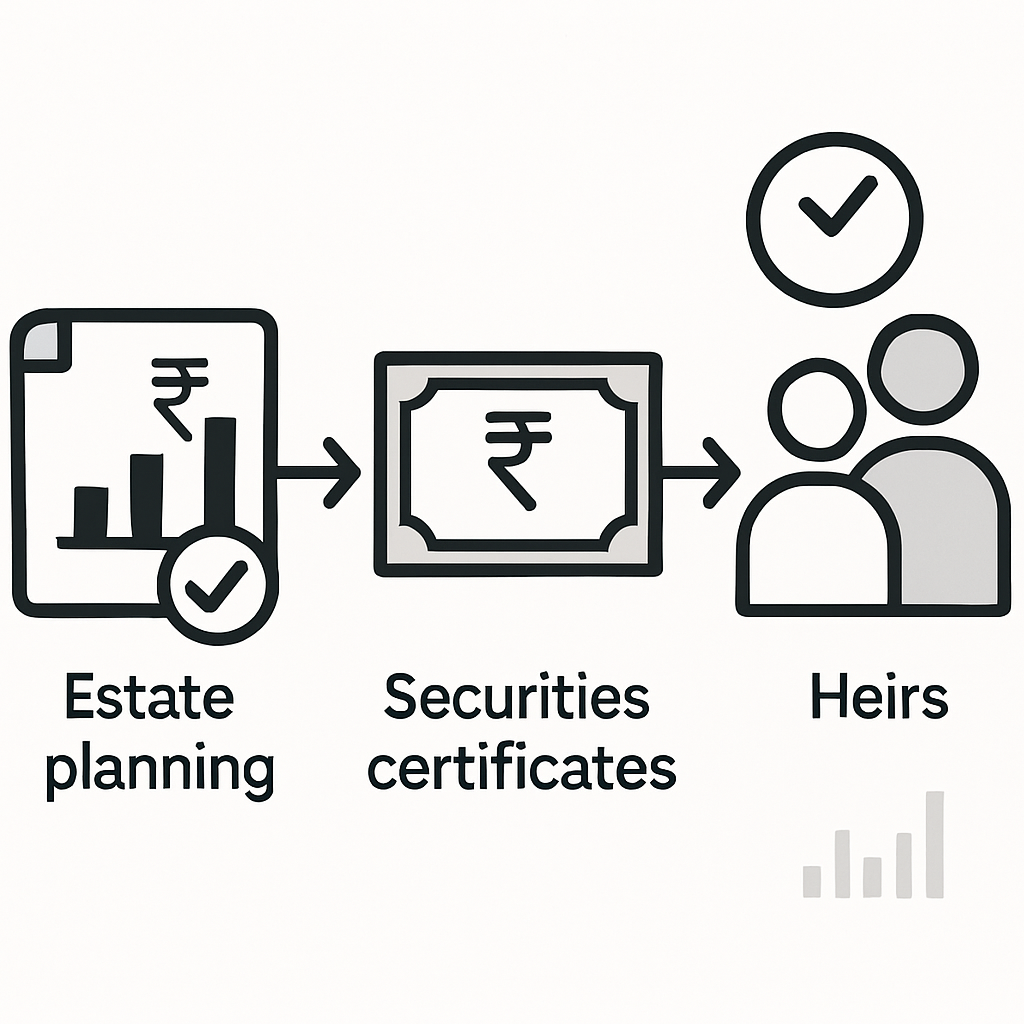
Estate planning should not stop at writing a will or buying life insurance. Investors should list demat accounts, mutual fund folios, broker accounts, bank mandates, nominee names, and key contact details in one place. SEBI’s New Fast-Track Securities Transmission works best when your family can quickly identify every holding and approach the correct institution with complete information.
Your estate file should cover shares, mutual funds, SIP folios, exchange-traded funds, bonds, PPF, NPS, EPF, bank accounts, insurance policies, and loans. If you track market-linked assets such as Nifty funds or Sensex ETFs, mention the platform, account number, and linked bank account so heirs do not depend only on emails or app access. Families should also understand how broader factors such as inflation, repo rate changes, oil prices, and currency moves can affect long-term planning, as discussed in our guide on how rupee weakness and oil shocks affect your wallet.
Drafting Wills with SEBI’s Fast-Track in Mind
A will should identify securities clearly instead of relying only on a vague phrase such as “all my investments.” Mention demat account numbers, mutual fund folios, broker names, depository participant details, and the intended beneficiaries for important asset classes. Clear drafting reduces confusion for heirs and helps institutions compare the will, nomination, and account records more easily.
Use legal advice when drafting or updating a will, especially if you have children from different marriages, dependent parents, NRI heirs, business-linked assets, or family members who may disagree. A lawyer can help ensure that the will is properly signed, witnessed, and stored in a way that can be used when needed. The goal is not just to create a legal document, but to create a practical roadmap that your heirs can follow.
Nomination Updates for Smoother Transmission
Nomination does not always decide final beneficial ownership, but it helps institutions identify who can receive or process the securities after the investor’s death. Keep nominee names, PAN details where applicable, mobile numbers, addresses, and relationship details updated with your depository participant, mutual fund platforms, registrars, and brokers. The nominee’s role becomes smoother when the will, family records, and institutional records tell the same story.
Review nominations after marriage, divorce, birth of a child, death of a nominee, relocation, or a major change in family relationships. Many transmission delays begin because nominees are outdated, addresses are incomplete, or the family does not know which accounts exist. A yearly nomination review is a simple habit that can save heirs significant stress later.
Stepwise Guide to Claim Securities Under SEBI’s Fast-Track Process
Heirs should first identify every investment account held by the deceased person. Check demat statements, Consolidated Account Statements, broker emails, bank statements, dividend credits, mutual fund transaction alerts, and physical records if any old holdings exist. You can also use the investor resources available on the NSE investor section for basic market and account awareness.
After listing the holdings, contact the relevant depository participant, registrar, broker, or asset management company. Ask for the latest transmission form, the applicable claim category, and the current document checklist under SEBI’s framework. Submit documents carefully, keep acknowledgements, note contact names, and track the request until the securities are transmitted to the claimant’s demat account or folio.
Documents Needed for Different Claim Values
For eligible small-value claims, heirs may generally need a death certificate, identity proof, address proof, claim forms, and a simplified affidavit or declaration. Larger or more complex claims may require additional documents such as a legal heir certificate, succession certificate, family settlement, court order, or other supporting proof. The exact requirement depends on the value of holdings, nomination status, relationship of the claimant, and whether any dispute exists.
Death certificates are usually obtained from municipal or local authorities, while legal heir documents may involve revenue authorities or courts depending on the state and situation. Heirs should avoid submitting incomplete files because missing documents can reset timelines or trigger repeated follow-ups. Before applying, compare names, dates, PAN details, addresses, and account numbers across all records to identify mismatches early.
Example Case Study: A Simple Securities Claim
Assume Meera’s father leaves listed shares and mutual fund units in a demat-linked investment account, and his nomination records match the family’s understanding. Meera contacts the depository participant and the relevant registrar, asks for the latest transmission checklist, and submits the death certificate, identity proof, claim form, and required declaration. Because the documents are consistent and there is no family dispute, the claim is more likely to move through the simplified route without unnecessary legal paperwork.
If another heir objects, the situation changes even if the documents were initially complete. The institution may pause transmission or ask the family to produce a settlement, legal heir proof, succession certificate, or court direction. This example shows why SEBI’s process helps most when estate records are clean and the family position is clear.
Handling Complexities: Disputes and Multi-Institution Holdings
SEBI can simplify documentation, but it cannot remove every family conflict. If two heirs dispute a will, nomination, family settlement, or ownership claim, the institution may not complete transmission until the dispute is resolved. This is why estate planning should include legal clarity, practical documentation, and open communication with close family members.
Many Indian investors now hold securities across multiple brokers, apps, mutual fund platforms, PMS accounts, employee stock plans, and old physical or converted holdings. NRIs may also hold Indian securities along with overseas bank deposits, foreign investments, or jointly owned family assets. If your family has cross-border assets, our article on why NRIs use FCNR(B) deposits in dollar planning can help you think about documentation and currency-linked planning issues.
Resolving Family Disputes Over Securities
Families should consider mediation and written settlement discussions before rushing into long court battles. A properly documented family settlement can help heirs agree on who receives specific securities, cash balances, mutual fund units, or other assets. Legal advice is useful because a poorly drafted settlement can create fresh disputes instead of resolving existing ones.
Legal heir certificates, succession certificates, letters of administration, or court orders may support claims where nominations are absent or contested. SEBI’s reforms reduce procedural hurdles, but they do not override genuine disputes among heirs. If conflict is likely, investors should address it during their lifetime through a clear will, updated records, and transparent communication where appropriate.
Managing Securities Across Multiple Platforms
Each institution may require a separate transmission request even if the heir is the same person. Keep one master tracker with demat details, folio numbers, broker names, registrar details, claim submission dates, acknowledgement numbers, and follow-up contacts. This prevents heirs from losing track of claims across different platforms and reduces repeated searches through emails or bank statements.
After transmission, heirs may review whether the inherited holdings should remain spread across many accounts or be consolidated for easier monitoring. This decision should be taken after considering tax impact, exit loads, investment goals, and family cash needs. Instead of making hurried sale decisions, heirs should consult a financial advisor and, where needed, a tax professional.
Post-Claim Financial Management and Tax Considerations for Heirs
Receiving inherited securities does not mean heirs should sell them immediately. The portfolio may contain long-term equity holdings, mutual funds, bonds, or concentrated positions that need a careful review. Heirs should consult a financial advisor before changing the portfolio, especially if the inherited assets are large compared with their existing savings.
Heirs should update demat, bank, KYC, FATCA, email, mobile number, and nomination details after transmission. They should also check whether dividends, interest, redemptions, or future sales affect income tax and ITR filing. For broader regulatory context, the SEBI website remains the main source for securities market circulars, consultation papers, and investor updates.
Tax Compliance After Securities Transmission
India does not currently levy a separate inheritance tax merely because a person receives securities from a deceased investor. Capital gains tax may apply when heirs sell inherited shares, mutual funds, bonds, or other taxable securities. The tax treatment can depend on the asset type, holding period, acquisition history, and available transaction records.
Heirs should preserve purchase records, statements, cost details, dates, and sale documents wherever available. In some cases, older records may need to be reconstructed from broker statements, demat records, registrar data, or mutual fund account statements. A chartered accountant or tax professional can help determine how gains should be computed and reported in the ITR.
Financial Steps for Heirs Post-Transmission
Once securities enter your account, update your own nominee details immediately. Review whether the inherited portfolio suits your goals, emergency fund needs, home loan plans, retirement timeline, and overall risk capacity. Consult a financial advisor before selling, switching, consolidating, or adding to inherited investments.
If the inheritance includes unlisted shares, business-related securities, employee stock options, or private market investments, additional valuation and legal checks may be needed. Our note on private market investments and growing Indian businesses may offer useful background for understanding such assets. These holdings can be less liquid than listed securities, so heirs should avoid rushed decisions without professional guidance.
Practical Tips and Documentation Best Practices for Indian Investors and Families
A simple estate folder can save your family months of confusion. Keep demat statements, mutual fund folios, bank details, insurance policies, PPF, NPS, EPF, loan documents, tax records, and nominee details together. Add a short note explaining where documents are stored, which email IDs are used for investments, and whom the family should contact first.
Review this folder at least once a year and after major life events such as marriage, divorce, birth, death, relocation, or a major asset purchase. Update nominations after switching brokers, opening new folios, changing bank accounts, or closing old accounts. The Reserve Bank of India’s RBI website can help families track banking rules, repo rate decisions, and financial stability updates that may affect broader household planning.
Maintaining Clear Records and Documentation
Store original death certificates, affidavits, succession papers, family settlement documents, and important investment records safely. Back up scanned copies in a secure digital folder that trusted heirs can access when needed. Do not rely only on mobile apps or passwords because heirs may not be able to access them after death.
Also list your depository participant, registrar contacts, broker login email, mutual fund platforms, bank relationship managers, and insurance contacts in plain language. Keep the list factual and avoid including passwords in unsecured documents. If digital access is important, use a secure password manager or a legally appropriate method that your trusted executor or family member can use when required.
When to Involve Legal and Financial Experts
Call a lawyer if heirs disagree, documents conflict, nominations are outdated, or an institution refuses a claim that appears valid. Legal advice is also useful for wills involving NRIs, minor children, second marriages, business assets, or properties in multiple states. Early advice can prevent small documentation issues from becoming long disputes.
Speak to a chartered accountant when inherited securities create capital gains, dividend income, interest income, foreign reporting issues, or complex ITR questions. Consult a financial advisor before restructuring inherited investments or using them for major goals. Professional help is especially valuable when the inherited portfolio is large, concentrated, tax-sensitive, or emotionally difficult for the family to manage.
FAQs on SEBI’s Securities Transmission Reforms for Indian Heirs
Families often learn about securities transmission only after a death, which makes the process feel urgent and emotional. SEBI’s New Fast-Track Securities Transmission can help, but heirs still need clean paperwork and consistent records. These common questions can help investors prepare before a crisis and help heirs understand what to expect.
Is probate always required after the SEBI reforms?
No, SEBI no longer treats probate as a mandatory requirement for every securities transmission claim. This can reduce time, legal cost, and procedural burden for many families where the documents are clear and there is no dispute. However, probate, a court order, or other legal proof may still be needed if heirs disagree, the will is contested, or the facts require additional validation.
What documents do small-value heirs need for fast-track claims?
Eligible small-value claims generally require basic documents such as a death certificate, identity proof, address proof, claim forms, and an affidavit or declaration. The institution may ask for more documents if names, PAN details, addresses, nominations, or family records do not match. Always request the latest checklist from the depository participant, registrar, broker, or asset management company before filing the claim.
Can family disputes delay the transmission process?
Yes, disputes can delay securities transmission even under the simplified SEBI process. Institutions may wait for a family settlement, legal heir certificate, succession certificate, court direction, or other proof before moving the securities. Mediation and clear documentation can often save time, cost, and family relationships.
How should heirs manage tax on inherited securities?
Receiving inherited securities does not by itself create a separate inheritance tax in India under current law. Capital gains tax may apply when heirs sell the inherited securities, and the calculation can depend on the asset, holding period, and available records. Heirs should preserve statements and consult a tax professional before filing returns involving inherited investments.
What should investors do now to help their heirs?
Investors should update nominations, prepare a clear will, and maintain a complete list of securities, folios, demat accounts, brokers, and bank links. They should also tell trusted family members where essential documents are stored and review the estate file every year. For investment decisions, portfolio restructuring, or goal planning, families should consult a financial advisor instead of making rushed choices during a stressful period.
Disclaimer: The information above is for educational purposes only and does not constitute financial advice.