


The 24,500 Zone Is More Than a Round Number
Nifty’s struggle around 24,500 has become a closely watched moment because it sits near a trend-deciding area for the index. A decisive move above this zone could strengthen expectations of an advance toward 24,600 and possibly 25,000, while repeated failure near the same area could signal hesitation. For investors, the level matters less as a magic number and more as a point where sentiment, positioning, and risk appetite may reveal the market’s next direction.
The current setup is being shaped by cautious market mood, global uncertainty, and the index’s ability to hold key support levels during pullbacks. Research references highlight 24,189 as an important near-term level and 23,468 as a deeper support area that may influence whether the recent correction is considered complete. These levels do not guarantee any outcome, but they can help investors understand whether strength is broadening or whether weakness is returning.
For long-term investors, the question is not simply whether Nifty touches 24,500 during the day. The more useful question is whether the index can sustain above it with follow-through, stable market breadth, and controlled volatility. Since market conditions can change quickly, investors should avoid making decisions from one price level alone and consult a financial advisor before acting on any investment plan.
What a Break Above 24,500 Could Signal
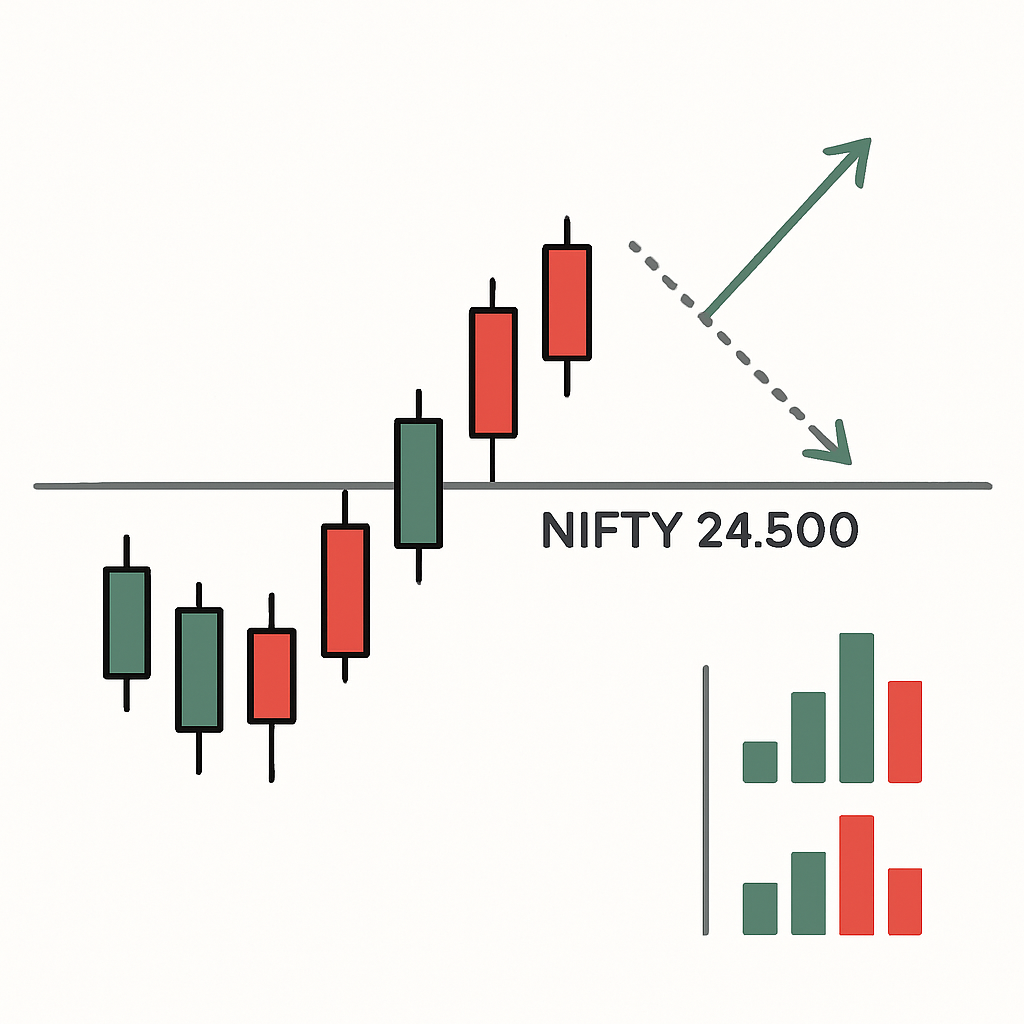
If Nifty sustains above 24,500, the market may interpret it as a sign that buyers are regaining control after a period of caution. Research points to 24,600 as an immediate upside area, with 25,000 discussed as a broader potential target if momentum strengthens. Such a move would likely require more than a brief intraday spike, because sustained closing strength is usually more meaningful than a quick move that fades before the session ends.
A confirmed break above 24,500 may also improve confidence in sectors that tend to benefit when risk appetite rises. However, the research does not support claims about guaranteed returns, sector-wide rallies, or specific stocks that must outperform. Investors should treat the level as a market signal, not as a command to buy, and should consult a financial advisor for guidance based on personal risk tolerance and time horizon.
Follow-through matters because markets often test important levels more than once before choosing a direction. If Nifty moves above 24,500 but struggles near 24,600, that may indicate that sellers are still active at higher levels. If it moves beyond 24,600 with broader participation, the market may begin to price in a stronger recovery toward the upper target zone discussed in the research.
What a Failure Near 24,500 Could Mean
If Nifty fails to hold above 24,500, the market may remain vulnerable to renewed weakness. A rejection from this zone could show that buyers are unwilling to chase prices higher while global uncertainty remains present. In that case, attention may shift back to support levels such as 24,189 and, if selling pressure deepens, 23,468.
The 24,189 level has been highlighted as a key near-term marker because it may help traders assess whether the index is merely consolidating or beginning to lose momentum. If Nifty stays above this area after testing 24,500, the broader structure may still remain constructive. If it falls below the area with weak breadth and poor recovery attempts, caution may increase across the market.
The 23,468 level carries broader importance because it has been referenced as a zone that could help confirm whether a correction is complete. A sustained move above that level has been discussed in the research as supportive for recovery toward higher zones, including 23,700–23,800 and eventually 24,500. If the index were to lose that area after another round of weakness, investors would need to reassess risk rather than assume every fall is a buying opportunity.
Why Market Sentiment Remains Cautious
The market’s hesitation around 24,500 is not happening in isolation. Research references mention global uncertainty and geopolitical tension as factors that have kept sentiment cautious. When global signals are unclear, domestic indices often become more sensitive to gap-up openings, sudden reversals, and changes in foreign market cues.
Caution is also visible when the index moves in a narrow range and investors wait for clearer signals. Rollover-related observations in the research suggest that participation has reflected a market still seeking direction. This does not mean the market must fall, but it does mean that a breakout may need confirmation before investors treat it as a durable shift.
Global developments can affect investor behavior even when the domestic economy remains stable. Crude oil prices, currency movement, geopolitical headlines, and global liquidity conditions can all influence short-term market confidence. Because these factors are difficult to predict, investors should use a disciplined framework and consult a financial advisor before changing portfolio allocations.
How Investors Can Read the 24,500 Battle Without Overreacting
The best way to read the 24,500 level is to observe price behavior rather than react emotionally to every tick. A single move above or below the level may not be enough to define the trend. Sustained closes, market breadth, sector participation, and the index’s ability to hold supports provide a more balanced picture.
Investors should also distinguish between trading signals and investment decisions. A trader may focus on intraday levels and stop-loss discipline, while a long-term investor may care more about valuation, earnings strength, and asset allocation. Since these objectives are different, a level like 24,500 should not be used in the same way by every market participant.
A practical approach is to treat 24,500 as a decision zone rather than a prediction. If the index sustains above it and moves toward 24,600 with stronger participation, confidence may improve. If it fails and slips toward 24,189, investors may need to watch whether weakness is controlled or expanding across the market.
The Role of 24,189 and 23,468 in the Bigger Picture
While 24,500 is receiving attention as the headline level, 24,189 and 23,468 are also important in the broader market structure. The 24,189 area can act as a near-term checkpoint if Nifty pulls back after attempting to move higher. A healthy market often holds key supports during pullbacks, while a weakening market tends to break them with limited recovery.
The 23,468 level is more significant for investors who are watching whether the recent correction has truly ended. Research suggests that sustaining above this level could support the view that the market has completed a corrective phase and may attempt higher levels. If the index remains comfortably above it, dips may be interpreted differently than they would be in a market that is breaking major supports.
These levels should not be treated as guaranteed turning points. Markets can overshoot levels in both directions, especially during news-heavy periods or volatile sessions. Investors should combine level-based analysis with portfolio goals, risk management, and professional guidance from a financial advisor.
Why Gap-Up Openings Need Extra Care
Research references warn against rushing into trades during gap-up openings, and that caution is especially relevant near 24,500. A gap-up can create the impression of strength, but it may also attract profit-taking if the move is not supported by follow-through. Investors who react too quickly may enter near a temporary high without confirming whether buyers remain active.
Gap-up sessions can be particularly deceptive when sentiment is mixed. The index may open strong because of overnight global cues, but domestic participants may use the strength to reduce exposure. This is why waiting for price stability, breadth confirmation, and closing strength can provide a clearer read than focusing only on the opening level.
For investors, the safer lesson is not to chase momentum without a plan. A structured approach considers entry discipline, risk tolerance, asset allocation, and the possibility that the market may reverse. Anyone considering changes to holdings should consult a financial advisor rather than relying only on a gap-up move near a major level.
What This Means for Your Next Investment Move
Nifty’s action near 24,500 can help investors decide whether the market backdrop is becoming more supportive or still demanding caution. If the index sustains above the level and moves toward 24,600, it may suggest improving sentiment. If it fails and drifts toward 24,189, it may suggest that investors are still unwilling to commit at higher prices.
Your next investment move should not be based only on whether Nifty crosses one level. A better decision process includes reviewing your portfolio mix, understanding your investment horizon, checking whether your holdings match your risk profile, and assessing whether you have enough diversification. Market levels can guide timing, but they should not replace a complete financial plan.
For investors already holding equity exposure, the 24,500 battle may be a signal to review rather than react. If the market strengthens, a disciplined investor can evaluate whether the portfolio is positioned appropriately for a recovery. If the market weakens, the focus should shift to risk control, quality of holdings, and consultation with a financial advisor.
A Balanced Framework for the Coming Sessions
The coming sessions may be shaped by whether Nifty can sustain above 24,500 or whether sellers continue to defend that zone. A move toward 24,600 would keep the upside discussion alive, while a strong follow-through could bring attention back to the broader 25,000 area. However, if the index cannot hold higher levels, traders and investors may again focus on 24,189 and 23,468.
A balanced framework avoids both fear and overconfidence. Bullish traders may want confirmation above resistance, while cautious investors may want evidence that support zones are holding. Long-term investors should focus on process, diversification, and professional guidance instead of making emotional decisions based on short-term volatility.
The battle at 24,500 matters because it sits at the intersection of sentiment and structure. It can indicate whether the market is ready to extend its recovery or whether it still needs more consolidation. The most sensible response is to watch the level carefully, avoid unsupported assumptions, and consult a financial advisor before making investment changes.
Frequently Asked Questions
The 24,500 level has become a major discussion point because it may help define Nifty’s near-term direction. Investors are watching whether the index can sustain above this area or whether it faces another rejection. The following questions address the key concerns without treating any market level as a guaranteed signal.
Why is 24,500 important for Nifty?
The 24,500 level is important because research identifies it as a trend-deciding zone for the index. A sustained move above it could improve expectations of an advance toward 24,600 and possibly 25,000. A failure near this level could suggest that the market remains cautious and may need more time before confirming strength.
What happens if Nifty breaks above 24,500?
If Nifty breaks and sustains above 24,500, market sentiment may improve in the short term. The next area discussed in the research is around 24,600, with 25,000 appearing as a broader upside possibility if momentum continues. Investors should still avoid treating the breakout as specific investment advice and should consult a financial advisor before acting.
What are the key support levels to watch?
The key support levels highlighted in the research are 24,189 and 23,468. The 24,189 level may help assess near-term strength after a pullback, while 23,468 may be more relevant for understanding whether a correction has ended or is deepening. If these levels fail during broad weakness, investors may need to reassess risk more carefully.
Should investors buy if Nifty crosses 24,500?
A move above 24,500 alone should not be treated as a direct buy signal for every investor. Investment decisions depend on personal goals, risk tolerance, time horizon, portfolio allocation, and the quality of individual holdings. Anyone considering a change should consult a financial advisor instead of relying only on one index level.
Why should investors be careful during gap-up openings?
Gap-up openings can look positive, but they do not always lead to sustained gains. Near a major level like 24,500, a strong opening may attract selling if buyers do not continue supporting the move. Waiting for confirmation through price stability and closing strength can help investors avoid reacting too quickly.
Disclaimer: The information above is for educational purposes only and does not constitute financial advice.
12 Comments