


Overview of Delhi Airport’s ₹3,500 Crore Bond Sale
Delhi Airport’s ₹3,500 crore bond sale is an important funding move for the operator of Indira Gandhi International Airport. Delhi International Airport Limited, or DIAL, operates IGIA under a concession arrangement with the Airports Authority of India. The money is intended to support expansion and infrastructure work at India’s busiest airport gateway.
A Moody’s update on Delhi Airport said stronger passenger traffic and progress in securing expansion funding reduced downside risks to the rating over the next 12 to 18 months. Moody’s affirmed DIAL’s B1 rating and changed the outlook to stable from negative. That does not remove financial risk, but it signals better confidence in the airport operator’s near-term funding position.
Purpose and Use of Funds
The bond proceeds are linked to Delhi Airport expansion and infrastructure upgrades. Such work can include terminal improvements, airside facilities, passenger-handling systems, and other capacity-related projects. These investments matter because a large airport must keep pace with business travel, tourism, family travel, and international connections.
Public information on Delhi and Indira Gandhi International Airport describes IGIA as the main gateway for Delhi’s domestic and international civilian air traffic. Terminal 3 was developed between 2007 and 2010 as a major airport modernisation project. The current bond funding fits into that longer cycle of expanding airport capacity and improving passenger facilities.
Why Bond Funding Matters
Large airport projects require heavy upfront spending, while revenue is collected gradually over many years. A bond sale allows the operator to raise long-term capital from investors instead of relying only on bank loans or internal cash flow. This can help match infrastructure costs with the useful life of the assets being built.
For investors, airport bonds are assessed on cash flow visibility, passenger traffic, tariff regulation, debt levels, and refinancing risk. For travellers, the key issue is whether expansion costs eventually appear in airport charges included in tickets. The bond sale itself does not automatically increase fares, but the recovery of project costs can become part of future tariff decisions.
How the Bond Sale May Affect Your Travel Costs
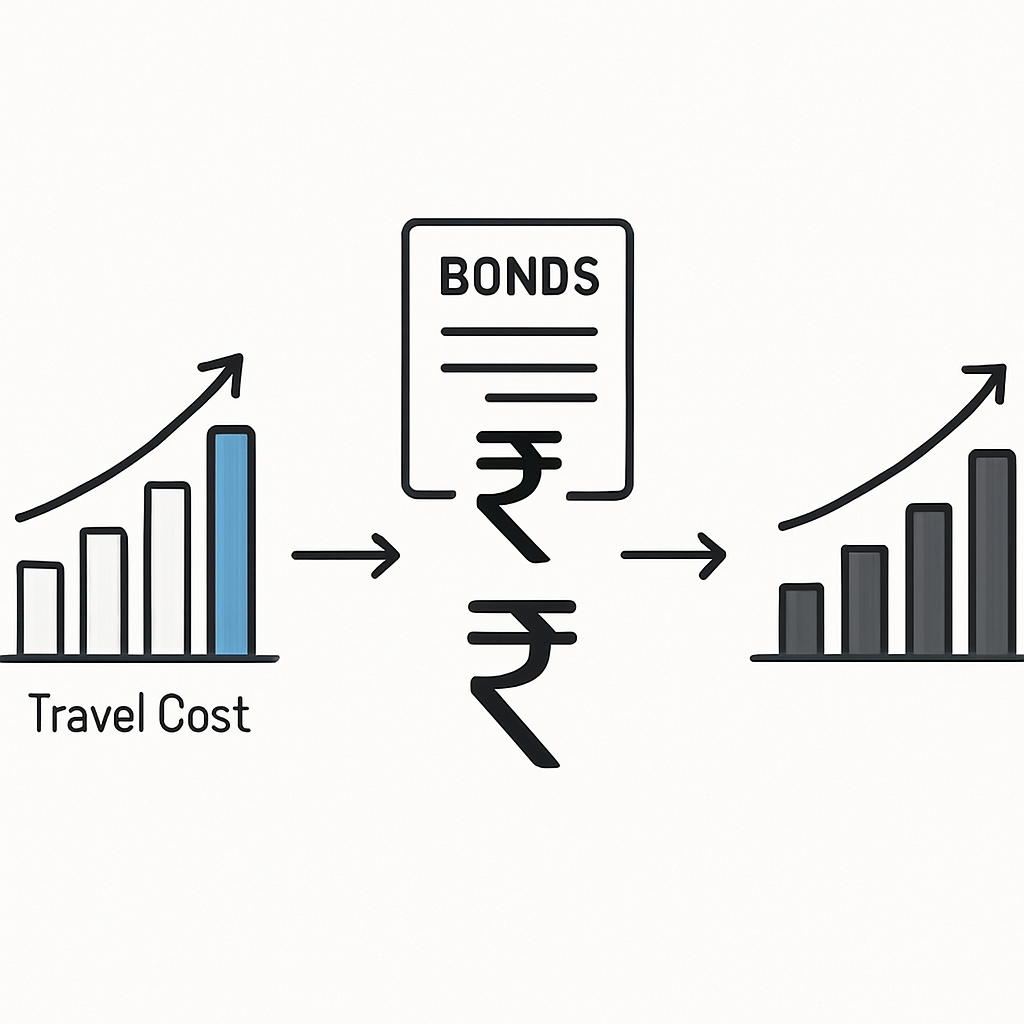
The most practical question for flyers is whether travelling through Delhi Airport will become more expensive. The answer depends on how regulators treat airport tariffs and how airlines pass charges to passengers. Bond funding is only one part of the cost chain, so it should not be read as a direct fare hike by itself.
Airport-linked charges usually form only one component of the total amount shown on a ticket. Airline fares also depend on fuel costs, route demand, competition, seasonality, and seat availability. A family booking during a holiday period may feel a much larger fare change from demand than from a small airport charge adjustment.
Understanding Airport Tariff Regulations
The Airports Economic Regulatory Authority, or AERA, regulates tariffs for major Indian airports. It examines costs, traffic projections, capital expenditure, and permitted returns before approving charges. This process can influence landing fees, parking charges, and passenger charges such as the User Development Fee.
An ETInfra report on Delhi and Mumbai airport tariff disputes said domestic air travellers could face higher passenger charges depending on the outcome of HRAB-related tariff calculations. The report linked the dispute to how airport operators may recover larger sums from passengers. This makes regulation a central factor in travel costs, alongside financing choices such as bonds.
Impact on Ticket Prices and Ancillary Charges
If AERA allows higher recovery of expansion costs, passengers may see a rise in airport-related charges over time. These charges can appear as UDF or other airport-linked components in the ticket breakup. The final ticket price will still be shaped by airline pricing, fuel costs, competition, and demand on the route.
Better infrastructure can also create benefits that are not visible in the ticket breakup. Faster passenger movement, better baggage systems, and reduced congestion can improve the travel experience. Travellers should compare total trip cost, convenience, and time saved rather than looking only at the base fare.
Delhi Airport Expansion: What Travellers Can Expect
Delhi Airport expansion is aimed at handling rising passenger demand with fewer operational bottlenecks. More capacity can help reduce crowding during peak travel periods and busy seasonal windows. This is especially relevant for families, students, business travellers, and international passengers using Delhi as a connection point.
Airport upgrades usually involve a mix of terminal work, airside capacity, digital systems, and passenger amenities. Travellers may benefit from more efficient check-in, security screening, boarding, and baggage handling. The exact timing of benefits will depend on execution, approvals, and the pace at which projects are completed.
Projected Infrastructure Upgrades
The bond proceeds may support projects connected to terminals, aircraft movement, passenger flow, and airport services. These are the types of investments needed when an airport has to serve more passengers without a sharp decline in service quality. DIAL’s approved capital plan and regulatory process will determine the final scope and recovery of these costs.
Technology can also play a major role in reducing airport friction. Automated gates, improved screening systems, and upgraded baggage processes can save time if implemented well. Indian travellers are already used to digital check-ins, UPI payments, and app-based services, so better airport technology can fit naturally into the travel journey.
Long-Term Benefits for Travellers
Over the long run, better airport capacity can improve reliability and reduce waiting time. Smoother operations can also help airlines manage schedules more efficiently during crowded travel periods. That matters during festivals, weddings, holidays, exam seasons, and major business events.
More passenger capacity can also support better commercial services inside the airport. Food outlets, lounges, retail stores, transport connections, and support services often expand when traffic rises. Whether prices inside the airport become more competitive will depend on contracts, demand, and consumer choice.
What the Bond Sale Means for Indian Retail Investors
Delhi Airport’s ₹3,500 crore bond sale also matters for people tracking fixed-income opportunities. Bonds can provide coupon income, but they are not the same as bank fixed deposits. Investors should review the rating, maturity, liquidity, taxation, and issuer risk, and they should consult a financial advisor before investing.
Indian households often compare bonds with PPF, EPF, NPS, debt mutual funds, fixed deposits, and other savings products. Infrastructure bonds may look attractive when investors seek alternatives to traditional deposits, but the risks are different. A stable outlook from a rating agency is helpful information, but it is not a guarantee of returns or safety.
How Individual Investors Can Participate
Retail participation depends on whether the issue is structured as a public offer, a private placement, or a listed security available in the secondary market. If a bond is listed, investors may be able to access it through approved brokers or recognised debt platforms. Minimum investment amounts, lot sizes, yields, and liquidity can vary across issues.
Investors can review broad market information through the NSE debt market and regulatory resources on the SEBI website. Offer documents should be read carefully because they explain the issuer, security structure, covenants, risks, and use of proceeds. Anyone unsure about suitability should consult a financial advisor before buying listed or unlisted debt products.
Risks and Expected Returns
Bond returns depend on coupon rate, purchase price, maturity, tax treatment, and interest rate movements. If market interest rates rise, existing bond prices may fall in the secondary market. If an investor sells before maturity, the realised return may be different from the coupon shown at the time of purchase.
Credit risk also matters even when the rating outlook has improved. Airport revenue depends on passenger traffic, tariffs, commercial income, operating costs, and regulatory clarity. Liquidity risk should also be considered because selling a bond quickly may not always be as easy as selling a widely traded stock.
Delhi Airport Bond Sale in India’s Aviation Finance Context
Airport financing in India often combines public-private partnerships, equity, bank loans, and bonds. DIAL’s concession structure reflects this model because the private operator invests in development while operating a public infrastructure asset. Bonds can complement other funding sources when expansion requirements are large and repayment timelines are long.
Bloomberg reported that GMR Airports was considering a large local-currency bond sale, showing wider interest in airport debt financing. Such activity suggests that infrastructure companies are increasingly looking at the domestic bond market for funding. It also gives investors more reason to understand how infrastructure debt differs from deposits, mutual funds, and equities.
Role of Public-Private Partnerships
Public-private partnerships can help modernise airports without depending only on government budgets. The private operator brings capital and operational expertise, while cost recovery is managed through regulated tariffs and commercial revenue. This model needs clear rules because passengers, investors, lenders, and operators all have different interests.
For travellers, the priority is fair pricing along with better service. For investors, the priority is stable cash flow, transparent regulation, and disciplined leverage. Delhi Airport’s ₹3,500 crore bond sale sits at the intersection of these two concerns.
Trends in India’s Infrastructure Bond Market
India’s infrastructure funding needs are large, and bonds can help finance assets with long operating lives. Airports, roads, metros, water systems, and urban services all require patient capital. As the debt market develops, more investors may study bonds alongside mutual funds, SIP portfolios, and retirement savings products.
Tax treatment should be checked before making any investment decision. Some fixed-income products may have different tax rules depending on structure, holding period, and investor category. Investors should consult a financial advisor or tax professional before linking any bond purchase with income tax planning.
Potential Financial Market Impacts
A successful airport bond sale can signal healthier credit market sentiment for infrastructure issuers. It shows that large operators can raise meaningful rupee funding when investors are comfortable with the risk profile. This matters because inflation, interest rates, and global risk appetite can influence demand for Indian debt.
Equity market investors may also watch airport-linked companies, lenders, and infrastructure groups after such funding moves. Funding stability can shape market views on aviation, transport, and public infrastructure. However, broader Nifty, Sensex, and BSE movements depend on many factors beyond one airport bond issue.
Market Reaction to Delhi Airport’s Funding Moves
Moody’s stable outlook can help reduce near-term uncertainty for investors assessing DIAL’s credit profile. Institutional investors generally prefer issuers with visible cash flows, regulated revenue frameworks, and progress on funding plans. The outlook change does not eliminate risk, but it provides a clearer signal than a negative outlook.
Interest rate expectations remain important for all fixed-income products. The RBI influences monetary conditions through policy tools such as the repo rate. When interest rate expectations change, bond yields and secondary-market prices can also move.
Future Outlook for Infrastructure Financing in India
Infrastructure bonds could become more relevant as India continues to build and upgrade public assets. Long-term assets need funding structures that do not depend only on short-term borrowing. If regulation and disclosures improve, more investors may become comfortable studying listed debt.
Recent market experience also shows why investors should not treat every infrastructure bond as low risk. Funding plans can be delayed, repriced, or changed if market demand weakens. The right approach is to examine each issuer, each bond structure, and each investor’s own risk capacity.
FAQs: Delhi Airport Bond Sale and Its Effects on Travellers and Investors
Delhi Airport’s ₹3,500 crore bond sale raises practical questions for both flyers and investors. The answers depend on regulation, market pricing, project execution, and each person’s risk profile. These FAQs offer general context and should not be treated as personal investment advice.
Will the bond sale increase my flight ticket prices?
The bond sale does not directly increase ticket prices by itself. Airport-related charges may rise if regulators allow higher recovery of expansion costs through tariffs such as UDF. Airline fares will still depend on fuel prices, competition, seasonal demand, and seat availability.
Can I invest in Delhi Airport’s bonds as a retail investor?
Retail investors can participate only if the bonds are offered to them directly or become available through listed secondary-market trading. Access may depend on the issue structure, minimum investment size, broker availability, and platform rules. Anyone considering such bonds should read the documents and consult a financial advisor.
What risks should investors consider in these bonds?
Investors should consider credit risk, interest rate risk, liquidity risk, and regulatory risk. Airport revenue can be affected by passenger traffic, tariff decisions, operating costs, and refinancing conditions. A stable rating outlook is useful, but it does not remove the possibility of price movement or loss.
How will the expansion improve traveller experience?
The expansion may improve passenger flow, reduce congestion, and support better airport facilities. Better infrastructure can help during peak travel hours and busy seasonal periods. Actual benefits will depend on project execution, approvals, and how quickly new capacity becomes operational.
Are these bonds tax efficient for Indian investors?
Tax efficiency depends on the bond structure and the current income tax rules. Interest income and capital gains may be treated differently depending on holding period and investor category. Investors should consult a financial advisor or tax professional before using any bond for tax planning.
Final Takeaway for Indian Travellers and Investors
Delhi Airport’s ₹3,500 crore bond sale is more than a financing headline. It connects airport expansion, passenger tariffs, infrastructure finance, and investor confidence in India’s aviation growth. For flyers, any near-term impact is more likely to appear through airport-linked charges than through a direct fare increase caused only by the bond sale.
For investors, the deal is a reminder to study infrastructure bonds carefully before committing money. Compare risks and liquidity with PPF, EPF, NPS, fixed deposits, debt mutual funds, and other fixed-income options. The sensible next step is to stay informed, read disclosures, and consult a financial advisor before making any investment decision.
Disclaimer: The information above is for educational purposes only and does not constitute financial advice.