


Why Indian bonds rallied after oil prices fell
Indian government bonds gained after crude oil prices slid, because lower oil prices can improve the outlook for inflation, government finances, and interest rates. The benchmark Indian 10-year bond yield fell to a 12-week low, with the yield on the 6.94 percent 2036 note dropping 3.2 basis points to 6.8637 percent in intraday trade. Bond prices and yields move in opposite directions, so a fall in yields means bond prices have risen.
The move was linked to relief in global energy markets after a US-Iran peace deal reduced immediate concerns about supply disruption. Before that relief, crude prices had moved above $80 per barrel, raising fears that India’s import-heavy energy bill could increase. When oil prices reversed lower, investors became more comfortable buying Indian government bonds, especially because cheaper crude can reduce pressure on consumer prices and the fiscal deficit.
For everyday savers and borrowers, the rally matters because government bond yields influence many parts of the financial system. They help shape expectations for bank deposit rates, loan pricing, bond fund returns, and broader market sentiment. A single market move does not immediately change every household rate, but it can signal where financial conditions may be heading if the trend continues.
How falling oil prices help India’s inflation outlook
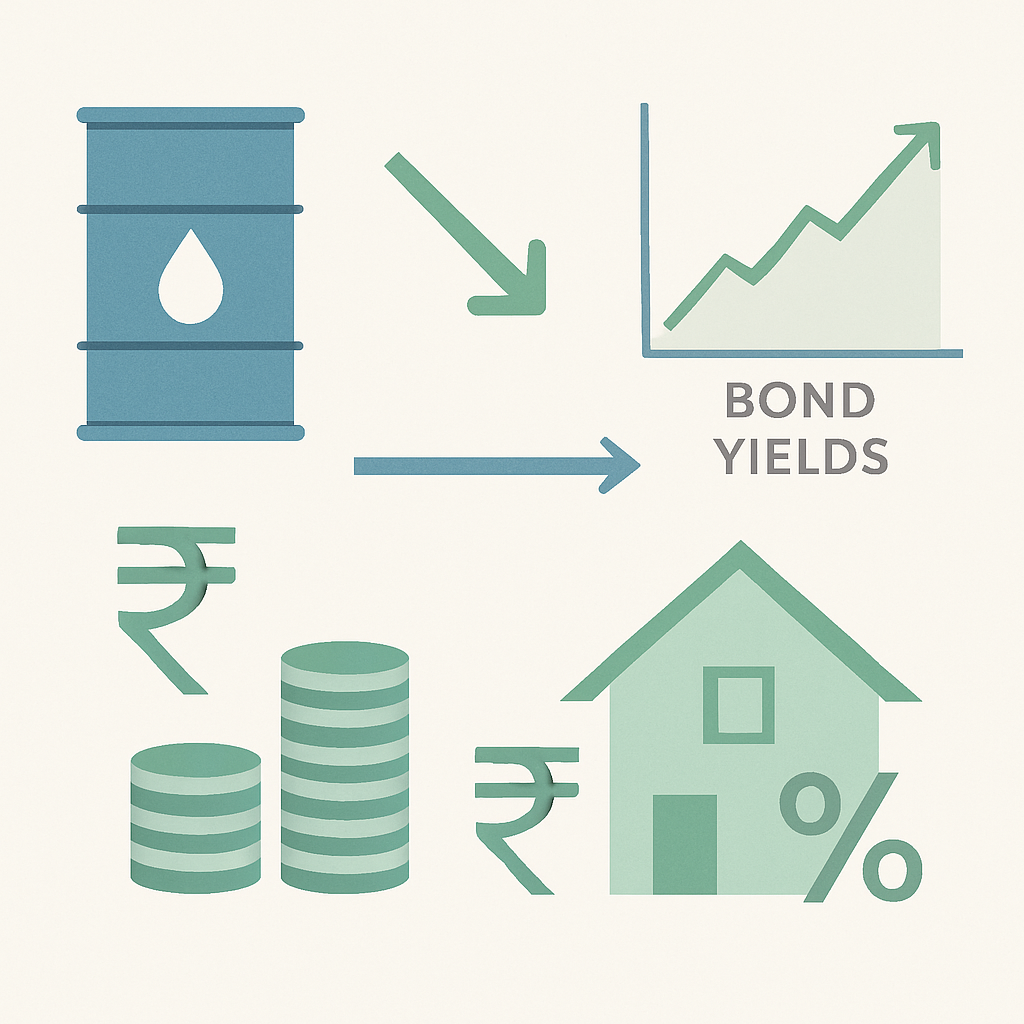
India imports a large share of its crude oil, so global oil prices are closely watched by policymakers, investors, and households. When oil becomes expensive, transport costs can rise and businesses may face higher input costs. Those costs can filter into prices for goods and services, which is why energy prices are often linked with inflation expectations.
Lower oil prices can ease some of this pressure, even if the impact is not always immediate at the petrol pump. Cheaper crude can reduce the cost burden on fuel marketing companies, transport operators, airlines, manufacturers, and other energy-sensitive sectors. If those cost savings persist, they may help soften inflation expectations across the economy.
This is one reason bond investors reacted positively to the oil price decline. Bond investors are highly sensitive to inflation because inflation reduces the real value of fixed interest payments. If investors believe inflation risk is easing, they may accept lower yields on government bonds, which pushes bond prices higher.
Why bond yields fall when investors become more confident
A government bond is a loan to the government, and the yield represents the return investors demand for holding that bond. When demand for bonds rises, their prices rise and their yields fall. This inverse relationship is central to understanding why a bond rally is usually described through falling yields.
In the latest rally, investors saw lower oil prices as a positive sign for India’s macroeconomic stability. Lower imported energy costs can support the rupee, reduce inflation concerns, and ease pressure on public finances. These conditions make fixed-income assets more attractive because the outlook for future interest rates may become less aggressive.
The fall in the benchmark yield to a 12-week low shows that investors were willing to buy Indian government bonds at lower returns than before. The yield was still reported to be about 20 basis points above pre-war levels, which suggests markets had not fully erased the earlier risk premium. Even so, the direction of the move showed that sentiment had improved compared with the period of higher oil stress.
What this means for fixed deposits and savings
For savers, lower bond yields can eventually influence the interest rates banks offer on fixed deposits and other savings products. Banks do not change deposit rates only because of one day’s bond market movement, but government yields are part of the broader interest-rate environment. If yields continue to soften and inflation pressure eases, banks may have less reason to offer very high deposit rates over time.
This does not mean deposit rates will fall immediately or uniformly. Banks also consider credit demand, liquidity, competition, and central bank policy before changing their rate cards. A saver comparing fixed deposits should therefore look at the full picture rather than reacting only to headlines about bond yields.
For households that rely on interest income, the key point is timing and diversification. Locking money into a long fixed deposit may provide certainty, but it may also reduce flexibility if personal cash needs change. Before making decisions about deposit tenures, bond funds, or any other savings product, it is better to consult a financial advisor who can assess your goals, tax position, and risk tolerance.
What this means for home loans and personal loans
Borrowers may wonder whether a bond rally will make loans cheaper. The link is real but indirect, because loan rates depend on bank funding costs, credit risk, competition, liquidity, and monetary policy. A lower government bond yield can contribute to easier financial conditions, but it does not guarantee an immediate fall in home loan, car loan, or personal loan rates.
Home loans are especially sensitive to the broader interest-rate cycle. If inflation cools and the Reserve Bank of India becomes more comfortable with the price outlook, banks may eventually get room to adjust lending rates. However, floating-rate borrowers should remember that policy transmission can take time, and banks may revise rates at different speeds.
Personal loans and credit card debt are different because they are priced mainly on borrower risk and lender margins. Even if government bond yields fall, unsecured loans may remain expensive for borrowers with weaker credit profiles. Borrowers should focus on improving credit scores, reducing high-cost debt, and comparing loan terms carefully before taking on new obligations.
Why lower oil prices can support government finances
Oil prices affect not only consumers and companies but also the government’s fiscal position. When oil rises sharply, the government can face pressure through fuel-related measures, fertilizer costs, and broader inflation management. Higher inflation can also complicate borrowing plans because investors may demand higher yields to compensate for risk.
When crude prices fall, some of those pressures ease. A lower import bill can improve the external balance, while lower energy inflation can reduce the need for costly interventions. This can help investor confidence in government bonds, because a more stable fiscal outlook reduces concerns about excessive borrowing pressure.
India’s bond market is particularly attentive to these signals because government borrowing is large and closely tracked. If investors believe the fiscal path is becoming easier, demand for government securities can improve. That is one reason the oil price drop was seen as supportive for Indian bonds after a period of geopolitical stress.
What bond fund investors should understand
Investors in debt mutual funds and bond funds may see the impact of falling yields through changes in net asset value. When yields fall, the market value of existing bonds generally rises, which can benefit funds that hold longer-duration securities. Funds with longer maturity profiles usually react more sharply to yield movements than short-duration funds.
This sensitivity can work both ways. If oil prices rise again, inflation concerns return, or global yields move higher, long-duration bond funds can also face mark-to-market losses. Investors should not assume that a bond rally makes every debt fund low-risk or suitable for every financial goal.
Institutional investors have shown interest in longer-duration Indian government bonds during the rally, but individual investors should be cautious about copying institutional positioning. Institutions often have different risk limits, holding periods, liquidity needs, and hedging tools. Anyone considering debt funds, direct bonds, or long-duration products should consult a financial advisor before investing.
Why oil prices are not the only factor driving bonds
Oil prices are important for India, but they are only one part of the bond market story. Domestic inflation data, Reserve Bank of India policy, government borrowing, banking liquidity, global bond yields, and currency movements also influence Indian yields. A drop in crude prices can improve sentiment, but the market still reacts to new economic data as it arrives.
Global developments also matter because foreign investors compare Indian bonds with other markets. If US yields move sharply higher, emerging-market bonds can face pressure even when domestic conditions look better. If global risk appetite improves, Indian bonds can benefit from stronger demand.
The oil price decline gave investors a clear reason to reassess inflation and fiscal risks, but the durability of the rally depends on whether those improvements last. A temporary drop in crude may give only short-term relief, while a sustained decline could have a deeper effect on expectations. Savers and borrowers should watch the trend rather than relying on one market session.
How households can respond without overreacting
Households should treat the bond rally as a useful signal, not as an instruction to make sudden financial changes. Falling yields can affect savings and borrowing conditions, but the transmission is gradual and uneven. A practical response is to review cash needs, loan exposure, deposit maturities, and investment allocation calmly.
Savers can check whether their emergency fund is adequate before thinking about returns. Borrowers can review whether refinancing makes sense, but only after comparing fees, reset terms, and total interest costs. Investors can examine whether their debt allocation matches their time horizon rather than chasing recent bond fund gains.
The best decisions depend on personal circumstances. A retiree seeking stable income, a young borrower with a floating-rate mortgage, and an investor saving for a short-term goal will all respond differently to the same bond market news. For personalized decisions, consult a financial advisor instead of relying on headline yield moves alone.
Risks that could reverse the bond rally
The rally in Indian bonds could weaken if crude oil prices rise again. Geopolitical tensions, supply disruptions, or stronger global demand can quickly change the energy price outlook. Because India is sensitive to imported energy costs, a renewed oil spike could revive inflation concerns and push yields higher.
Inflation data can also alter the direction of the market. If food inflation, fuel costs, or core inflation remain sticky, investors may become less confident about lower yields. In that situation, the Reserve Bank of India may maintain a cautious stance for longer, which could limit further bond gains.
Global financial conditions are another risk. A stronger dollar, higher US Treasury yields, or weaker emerging-market flows can pressure Indian bonds even when domestic news is supportive. Bond investors therefore need to balance the positive impact of lower crude with the broader set of risks facing fixed-income markets.
What to watch next
The first thing to watch is whether crude prices remain lower or rebound. A sustained decline would give investors more confidence that inflation pressure is easing. A sharp rebound would reduce the comfort that powered the latest bond rally.
The second factor is domestic inflation and central bank commentary. If inflation data softens and policymakers sound more comfortable, bond yields may remain supported. If inflation stays high or policy language remains cautious, the rally could lose momentum.
The third factor is how banks respond over time. Deposit and lending rates do not move instantly with government bond yields, but persistent changes in the yield curve can influence bank pricing decisions. Households should monitor actual rate offers from banks rather than assuming that market yields will immediately change their savings income or loan payments.
Frequently Asked Questions
The fall in oil prices matters for Indian bonds because it can reduce inflation pressure and improve India’s external and fiscal outlook. Since India imports a large share of its crude oil, cheaper oil can lower the risk that fuel and transport costs feed into wider price increases. When investors see lower inflation risk, they may buy more bonds, which pushes bond prices up and yields down.
Why did Indian bonds rally after crude oil prices fell
Indian bonds rallied because investors viewed lower crude prices as positive for inflation, government finances, and market stability. The benchmark yield fell to a 12-week low, showing stronger demand for government securities. The move also reflected improved global bond sentiment after geopolitical concerns eased following the US-Iran peace deal.
Will fixed deposit rates fall because bond yields declined
Fixed deposit rates may be influenced by lower bond yields over time, but they do not automatically fall after one market move. Banks consider liquidity, loan demand, competition, and central bank policy before changing deposit rates. Savers should compare available rates and consult a financial advisor before making large changes to deposit tenures.
Will home loan EMIs become cheaper soon
Home loan EMIs do not usually change immediately because government bond yields fall. Loan rates depend on bank policies, benchmark resets, borrower profiles, and the broader monetary policy cycle. If inflation continues to ease and financial conditions soften, borrowers may eventually see better loan pricing, but timing can vary by lender.
Are bond funds safer now after the rally
Bond funds may benefit when yields fall, especially funds holding longer-duration bonds. They still carry interest-rate risk, because yields can rise again if oil prices rebound, inflation surprises markets, or global bond yields move higher. Investors should consult a financial advisor before choosing bond funds, particularly if they are considering long-duration products.
What should ordinary savers do now
Ordinary savers should avoid reacting hastily to market headlines and instead review their full financial plan. The bond rally is a positive signal for the inflation and interest-rate outlook, but it is not a guarantee that all savings and loan rates will move immediately. A balanced approach includes maintaining an emergency fund, comparing rates carefully, and getting professional advice for investment decisions.
Disclaimer: The information above is for educational purposes only and does not constitute financial advice.
3 Comments