


Why the Yes Bank AT1 Verdict Matters for Fixed Income Investors
The Supreme Court ruling on Yes Bank’s AT1 bond write-off has changed how many Indian investors view fixed income risk. If you hold bank bonds, debt mutual funds, or high-yield debt products, this verdict deserves close attention. The case is a reminder that fixed income does not always mean fixed safety, especially when the product has complex loss-absorption clauses.
The Supreme Court upheld the Bombay High Court’s decision to quash Yes Bank’s ₹8,415 crore Additional Tier-1 bond write-off. This is a major development in a dispute that began during Yes Bank’s 2020 rescue. For investors, the verdict improves confidence in legal review, but it does not remove the underlying risks attached to AT1 bonds.
Understanding AT1 Bonds and Their Role in Banking
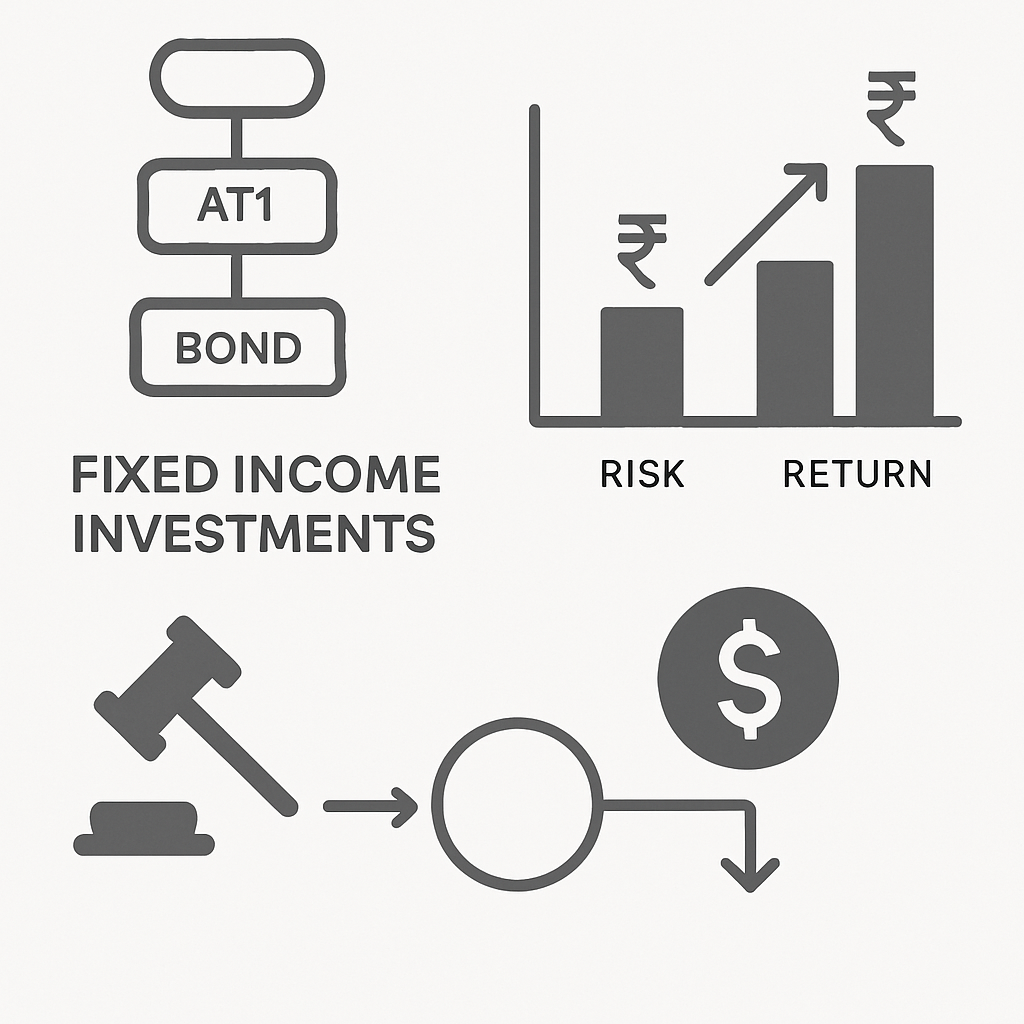
AT1 bonds, or Additional Tier-1 bonds, are debt-like instruments issued by banks to support regulatory capital requirements. They help banks strengthen their capital base under RBI’s Basel III framework and act as a buffer during periods of stress. These instruments sit below many other forms of debt in the repayment hierarchy, which makes them riskier than ordinary fixed income products.
Unlike a bank fixed deposit, an AT1 bond does not offer simple principal protection. Coupon payments may be skipped if the bond terms and regulatory conditions allow it, and the principal may face write-down in a stress event. Investors usually expect higher yields from AT1 bonds because they carry higher credit risk, coupon risk, liquidity risk, and loss-absorption risk.
How AT1 Bonds Differ From Regular Bonds
Banks issue AT1 bonds to meet capital rules, not merely to borrow like a normal company issuing a standard bond. These bonds are usually perpetual, which means they do not have a fixed maturity date like many corporate bonds. They may have call dates, but investors should not treat a call date as guaranteed redemption.
Coupon payments may look attractive when compared with fixed deposits or government securities, but the legal terms matter more than the headline yield. If a bank comes under stress, the terms of the instrument may allow coupon cancellation or principal loss. Investors should read the information memorandum and review regulatory context on the RBI website before considering such products.
AT1 Bonds Versus Safer Fixed Income Options
Fixed deposits, government securities, PPF, EPF, and high-quality short-duration debt products are generally easier for retail investors to understand. AT1 bonds are more complex because the investor is taking exposure to a bank’s capital structure and stress-resolution framework. A higher coupon should be seen as compensation for additional risk, not as free extra income.
Many households compare fixed income products only by return, which can be misleading. A product with a higher yield may carry more credit risk, lower liquidity, or uncertain repayment timing. Before choosing between bank bonds, debt mutual funds, NPS, PPF, EPF, or fixed deposits, investors should consult a financial advisor who can assess their goals, tax position, liquidity needs, and risk capacity.
The Supreme Court Verdict on Yes Bank AT1 Bonds
The Supreme Court upheld the Bombay High Court order that quashed Yes Bank’s ₹8,415 crore AT1 bond write-off. According to Bar & Bench’s report on the Supreme Court order, the Court declined to interfere with the High Court judgment. This makes the verdict a significant milestone in a legal battle linked to the bank’s 2020 reconstruction.
The ruling is positive for bondholders who challenged the write-off, but the exact financial outcome may depend on the operative parts of the judgment and further implementation steps. As NDTV Profit’s analysis of the Yes Bank AT1 verdict noted, the mechanics of restoration, repayment, or interest treatment require careful reading of the final order. Investors should avoid assuming that every AT1 bond dispute will produce the same result.
Background of the Yes Bank AT1 Write-Down
Yes Bank faced severe financial stress before its 2020 reconstruction. During the rescue process, around ₹8,415 crore of AT1 bonds were written down, which caused substantial losses for bondholders. Those investors then challenged the write-down before the courts, leading to a long-running dispute.
The case attracted attention because both institutional and retail investors had exposure to the bonds through different routes. The NDTV Profit explainer on the Yes Bank AT1 bond case gives useful background on how the dispute affected bondholders and the bank. The controversy also raised wider questions about disclosure, product suitability, and the treatment of bondholders during bank rescues.
Investor Protection and Market Uncertainty
The verdict strengthens the idea that legal process matters when regulators, banks, and investors deal with a stressed financial institution. Bondholders may feel more confident that major losses can be reviewed by courts if they believe due process was not followed. This can support trust in India’s fixed income market over time.
The ruling may also create uncertainty for banks planning future AT1 issuances. As reported by Livemint on the Yes Bank AT1 ruling, market participants expect an immediate impact on the AT1 bond space. Investors may demand higher compensation from weaker banks, and that could raise borrowing costs for some issuers.
Key Risks Retail Investors Should Understand
Retail investors often see bonds as safer than shares because bond prices may appear less volatile on a day-to-day basis. That perception can be dangerous when the borrower is weak or the bond has unusual terms. AT1 bonds combine credit risk, coupon uncertainty, liquidity risk, perpetual maturity, and possible write-down risk.
Equity risk is visible because prices on the NSE or BSE move regularly, while bond risk can remain hidden until a credit event occurs. A bond may appear stable for months and then suddenly face a sharp valuation change if the issuer’s condition worsens. This is why investors should understand the structure before chasing a high coupon.
Credit Risk and Loss Absorption
Credit risk means the issuer may struggle to pay interest or return money. In AT1 bonds, this risk is sharper because the instrument is designed to absorb losses when the issuing bank comes under stress. The bondholder can suffer loss before many other creditors, depending on the legal terms and regulatory framework.
This feature exists because regulators want banks to hold capital buffers that can protect depositors and the broader financial system. From the banking system’s perspective, such capital can support stability during stress. From an individual investor’s perspective, the same feature can lead to large losses if the bank weakens.
Reading Bond Terms Before Investing
Before buying an AT1 bond, investors should read the information memorandum, risk factors, call provisions, coupon discretion clauses, and write-down triggers. They should also review the issuer’s financial position, capital adequacy, asset quality, and credit rating rationale from agencies such as CRISIL or ICRA. If the terms are difficult to understand, they should consult a financial advisor rather than relying only on a distributor’s explanation.
Investors should not rely only on the headline yield shown in a product presentation. SEBI requires disclosures in regulated offer documents, and investors can review rules, circulars, and alerts through the SEBI portal. Written terms matter more than verbal assurances, especially in complex debt products.
Portfolio Diversification After the Verdict
The Supreme Court verdict should encourage investors to review concentration risk across their fixed income holdings. A single bank bond, NBFC bond, credit-risk fund, or high-yield product should not determine the safety of a household’s long-term financial plan. Diversification cannot remove all risk, but it can reduce the damage from one issuer-specific event.
A fixed income portfolio may include different categories such as government securities, bank deposits, high-quality bonds, debt mutual funds, PPF, EPF, or NPS, depending on the investor’s needs. The right mix is not the same for every household because age, income stability, liquidity requirements, taxation, and risk tolerance differ. For broader market context, you can also read PocketPlanGuru’s guide on what the FII selloff means for your investments.
Building a Balanced Fixed Income Portfolio
A balanced fixed income portfolio should not depend too heavily on high-yield debt. Investors should understand why a product offers a higher return before adding it to their portfolio. If the reason is higher credit risk, lower liquidity, or complex legal terms, the investment needs extra caution and professional review.
Debt mutual funds can offer diversification, but they are not risk-free. Liquid funds, short-duration funds, corporate bond funds, and credit-risk funds carry different levels of interest rate risk and credit risk. Investors should consult a financial advisor before selecting funds or bonds, especially when the product holds lower-rated securities or complex bank capital instruments.
Monitoring and Rebalancing Holdings
Fixed income portfolios need regular review rather than blind holding. Investors should track RBI policy actions, inflation trends, repo rate changes, issuer results, and credit rating changes. These factors can affect bond prices, bank funding costs, debt fund returns, and reinvestment decisions.
Investors can also track bond market data and listed securities through the NSE website. If a bond rating falls or an issuer reports weaker financials, the exposure should be reviewed carefully with a financial advisor. Rebalancing can help reduce concentration before a credit problem becomes more serious.
Regulatory Landscape and Possible Reforms
The verdict may push regulators and market participants to make AT1 risks clearer for investors. RBI and SEBI may review disclosure standards, investor eligibility, suitability checks, and grievance processes for complex debt instruments. Clearer rules can help banks raise capital while ensuring investors understand what can happen during stress.
India’s fixed income market has grown beyond fixed deposits and postal savings schemes. Investors now access corporate bonds, listed debt, debt mutual funds, structured products, and market-linked instruments. This growth makes investor education essential, just as equity investors need to understand IPOs, Nifty movements, Sensex trends, and market cycles.
Current Rules Around AT1 Bonds
RBI’s Basel III framework governs how banks issue AT1 bonds and use them as regulatory capital. SEBI rules require disclosures when securities reach investors through regulated channels. Even so, many retail investors struggle with terms such as write-down, coupon discretion, loss absorption, call option, and perpetual maturity.
This knowledge gap can create mis-selling concerns when a product is marketed mainly through its high coupon. A bank bond may sound similar to a fixed deposit in casual conversation, but the legal rights can be very different. Investors should ask for written product documents and consult a financial advisor before investing in complex debt products.
What Reforms Could Mean for Investors
Future reforms may focus on clearer risk labels, stronger warnings, and better product classification for AT1 bonds and similar instruments. Regulators may also consider whether retail investors need suitability checks before buying complex capital instruments. Any reform should balance investor protection with the need for banks to raise capital efficiently.
The Supreme Court verdict may influence how future bank resolution documents are drafted. Regulators, banks, and investors will need more clarity on when loss absorption can occur and what process must be followed. That clarity will shape investor confidence, issuer borrowing costs, and the future size of India’s AT1 bond market.
Practical Steps for Investors Now
Investors should begin by listing every fixed income product they own. This list should include fixed deposits, bonds, debt mutual funds, PPF, EPF, NPS, small savings products, and any private debt or high-yield product. It should also include related liabilities such as a home loan, personal loan, or credit card balance, because liabilities affect liquidity needs and risk capacity.
After making the list, investors should identify which holdings carry issuer risk, market risk, liquidity risk, maturity risk, or product complexity. If they hold AT1 bonds or lower-rated bank debt, they should review the offer document and recent issuer disclosures. For interest rate context, PocketPlanGuru’s guide on why RBI’s repo rate hike matters for your home loan can help connect monetary policy with personal finances.
Assessing Current Fixed Income Exposure
Investors should check whether one issuer, sector, or product type dominates their portfolio. They should map expected cash flows, coupon dates, call dates, and maturity dates wherever applicable. For perpetual products, they should not assume that a call date is the same as guaranteed repayment.
Credit ratings should be reviewed along with the rating rationale, not just the symbol. Recent financial results, regulatory actions, and exchange filings can also provide useful signals about issuer health. If a product looks too complex or the investor is unsure about risk, the next step should be to consult a financial advisor.
Finding Reliable Information
Reliable information should come from official and traceable sources. RBI and SEBI portals are useful for circulars, rules, and investor alerts, while exchange filings on NSE or BSE can provide issuer-level updates. Credit rating agency reports can explain why a rating was assigned, upgraded, downgraded, or placed under watch.
Investors should also connect bond risk with broader investing behaviour. PocketPlanGuru’s article on why smart investors watch India’s IPO frenzy can help readers think beyond hype and headline returns. Whether the product is equity, debt, gold, insurance, or a tax-saving option, disciplined review is safer than return-chasing.
FAQ: Common Questions About Yes Bank AT1 Bonds
The questions below address common doubts after the Supreme Court verdict. They are for general education and should not be treated as personalised investment advice. Investors should consult a financial advisor before buying, selling, or holding complex fixed income products.
What are AT1 bonds and why were Yes Bank’s bonds written down?
AT1 bonds are perpetual bank capital instruments that help banks meet regulatory capital requirements. Yes Bank’s AT1 bonds were written down during its 2020 reconstruction, which caused substantial losses for bondholders. The bondholders challenged the action, and the courts later quashed the write-off.
Does the Supreme Court verdict mean all AT1 bonds are safe?
No, AT1 bonds still carry higher risk than fixed deposits or government securities. The verdict improves confidence that legal process can be reviewed, but it does not eliminate credit risk, coupon risk, or write-down risk. Investors should read the terms carefully and consult a financial advisor before investing.
Should retail investors avoid AT1 bonds after this verdict?
Retail investors should be cautious with AT1 bonds because they are complex products. They may be suitable only for investors who understand bank capital structures, perpetual maturity, coupon discretion, and loss absorption. If there is any doubt, investors should consult a financial advisor before investing or exiting.
How can investors identify relatively safer fixed income choices?
Relatively safer choices often include government securities, bank fixed deposits, PPF, EPF, and high-quality debt products, depending on the investor’s goals. Safety also depends on liquidity, taxation, lock-in, interest rate risk, and issuer strength. Investors should compare all these factors with a financial advisor before making decisions.
What regulatory changes may follow this verdict?
Investors may see stronger disclosures, clearer risk warnings, and better classification for complex debt products. Regulators may also review how AT1 bonds and similar instruments are sold to retail buyers. The goal should be stronger investor protection without damaging the ability of banks to raise capital.
Final Takeaway for Indian Fixed Income Investors
The Supreme Court verdict on Yes Bank AT1 bonds is a landmark moment for India’s debt market. It gives bondholders an important legal victory, but it does not make AT1 bonds simple or risk-free. Higher yield still needs to be evaluated against credit risk, liquidity risk, product structure, and legal terms.
Investors should review their fixed income portfolios, check concentration risk, and understand every product they hold. Complex instruments such as AT1 bonds should be assessed with the help of a financial advisor. Keep learning before investing, and use PocketPlanGuru’s practical finance guides to build a safer and more informed money plan.
Disclaimer: The information above is for educational purposes only and does not constitute financial advice.