


Why This Ex-Date Week Matters for Indian Investors
More than 110 Indian stocks, including Wipro, UltraTech Cement and Britannia, are turning ex-date this week for dividends and bonus issues, according to The Economic Times report on ex-date stocks. For dividend-focused investors, this makes the corporate action calendar especially important. The main point is not just the cash payout, but whether the investor is eligible on the correct date and understands the tax and price impact.
Wipro, UltraTech Cement and 110+ dividend stocks turning ex-date can create short-term excitement in the market. Some investors may try to buy shares before the ex-date to receive the declared dividend, while others may simply review whether their existing holdings qualify. Before acting on any such list, investors should verify the record date, ex-date and company announcement from official exchange filings or company investor relations pages.
Understanding Ex-Dividend Dates in the Indian Stock Market
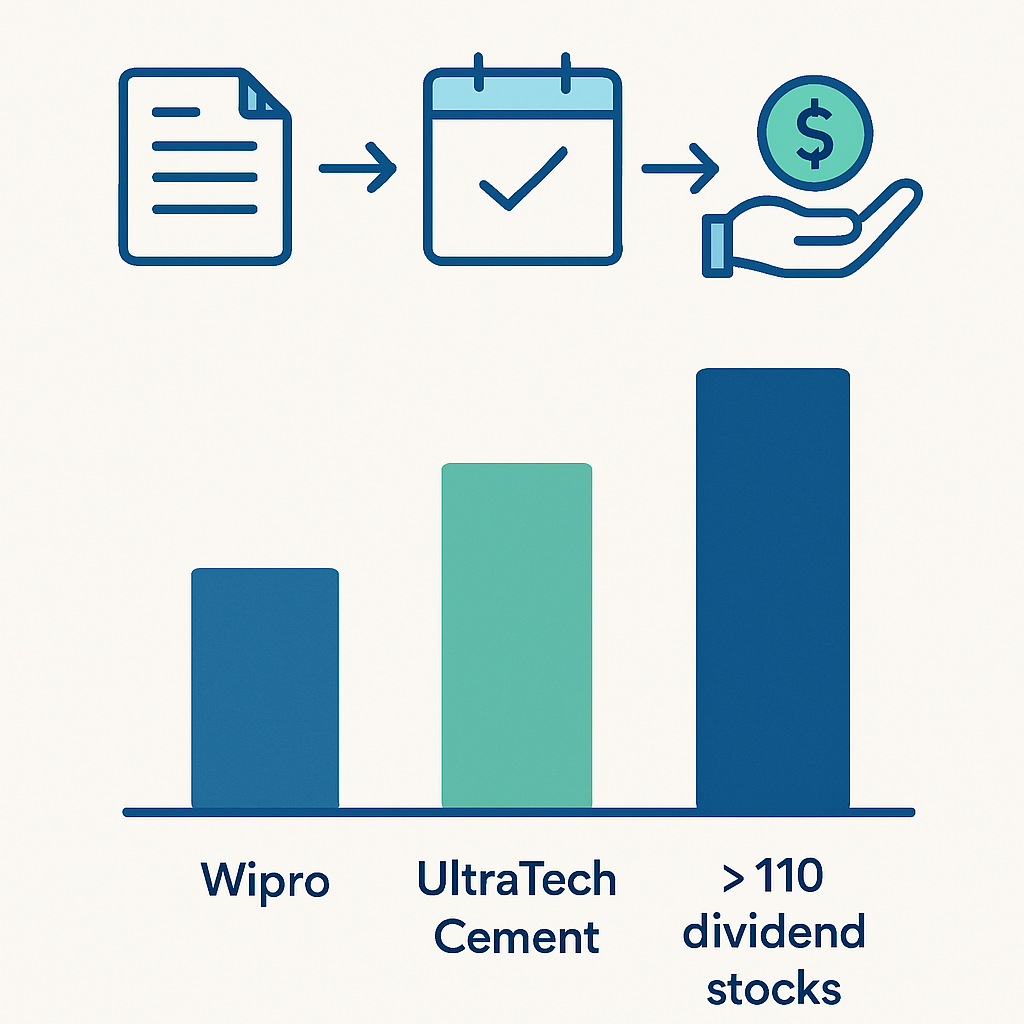
An ex-dividend date is the date from which a stock starts trading without the right to receive the upcoming dividend. If an investor buys the stock on or after the ex-dividend date, that investor will generally not receive the declared dividend. This concept is also explained in simple terms by Dividend.com’s ex-dividend date guide, which describes how dividend entitlement changes around the ex-date.
The record date is the date used by the company to identify eligible shareholders in its records. In India’s settlement system, the trade date and settlement date matter because shares must be credited in time for eligibility. Investors who are unsure about a holiday, settlement issue or demat credit should consult their broker and, where needed, consult a financial advisor before making a decision.
What the Ex-Date Means
The ex-date is a market date, not just a company announcement date. From this date onward, the share trades without the benefit of the upcoming dividend or relevant corporate action. This is why investors tracking dividend income usually check both the ex-date and the record date before placing any trade.
Record Date and Payment Date
The record date is the cut-off date on which the company checks its shareholder records. The payment date comes later, when the dividend amount is credited to eligible shareholders through the banking details linked to their demat or folio records. A delay in bank mandate updates, KYC details or demat transmission can create avoidable problems, so investors should keep records current.
India’s T+1 Settlement Cycle
India follows a T+1 settlement cycle for equities, which means trades are generally settled one working day after the transaction date. To be eligible for a dividend, an investor generally needs to buy the shares before the ex-dividend date so that settlement aligns with the record date. Market holidays can change the practical timing, so investors should verify the exchange calendar before relying on any rule of thumb.
Wipro, UltraTech Cement and Other Stocks in Focus
The current ex-date calendar has attracted attention because it includes widely tracked names such as Wipro, UltraTech Cement and Britannia. The Economic Times report says more than 110 companies are turning ex-date this week for dividends and bonus issues. UltraTech Cement’s final dividend of Rs 240 per share has also been highlighted in market coverage, including Trade Brains coverage of stocks trading ex-dividend.
A high dividend amount can look attractive, but it should not be viewed in isolation. Dividend yield depends on the dividend amount and the share price, while long-term returns also depend on earnings, valuation and business performance. Investors comparing dividend stocks with mutual funds, fixed deposits, PPF, NPS or EPF should consider total return, tax impact and liquidity together.
Wipro Dividend Considerations
Wipro is a widely followed technology company, and many Indian investors track its corporate actions closely. A dividend announcement may interest income-focused shareholders, but it does not by itself decide whether the stock is suitable for a portfolio. Investors can review company filings, annual reports and exchange announcements, and they should consult a financial advisor before making portfolio changes.
Technology companies often balance dividends with reinvestment, buybacks, acquisitions and business expansion. For Wipro, factors such as revenue growth, margins, global technology demand and deal activity can influence investor expectations. The ex-date is only one event in a broader investment picture, so short-term dividend timing should not replace a full review of the business.
UltraTech Cement Dividend Considerations
UltraTech Cement’s Rs 240 per share final dividend makes it one of the most watched payouts in this ex-date cycle. Cement businesses can be affected by infrastructure demand, housing activity, freight costs, power costs and broader economic conditions. A dividend can support shareholder income, but the company’s valuation and sector cycle remain important for overall returns.
Investors should avoid treating a large rupee dividend as automatic profit. When a stock turns ex-dividend, the market price may adjust because cash is leaving the company. For broader context on how macro pressures can affect household finances and portfolios, readers can review PocketPlanGuru’s analysis on rising crude prices and their impact on your money.
Other Dividend Stocks to Track
Beyond Wipro and UltraTech Cement, investors often track dividend announcements from sectors such as FMCG, banking, utilities, manufacturing and public sector companies. Britannia is among the well-known names mentioned in the broader ex-date coverage. However, each company’s payout should be assessed through official filings rather than social media posts or forwarded screenshots.
Public dividend calendars can be useful for quick screening, but Indian exchange filings should remain the final reference for NSE and BSE stocks. International dividend calendars such as DividendStocks.com’s ex-dividend calendar may help explain the format of dividend data, but they are not a substitute for Indian company announcements. Investors should cross-check the ex-date, record date and dividend amount before relying on any third-party calendar.
Tax Considerations on Dividends in India
Dividend income is taxable in the hands of investors in India under the current tax framework. This means dividends are added to the investor’s total taxable income and taxed according to the applicable slab rate. As a result, two investors receiving the same dividend may have different post-tax outcomes.
Tax can materially affect the result of a dividend capture attempt. An investor in a higher tax slab may retain less of the dividend after tax than expected. Anyone planning around large dividend receipts should consult a financial advisor or tax professional before relying on the gross payout amount.
Tax Deducted at Source on Dividends
For resident individuals, companies generally deduct TDS at 10% when dividend payments exceed Rs 5,000 in a financial year, subject to applicable income tax rules. If PAN details are not available or are not valid, a higher deduction rate may apply. Investors can claim TDS credit while filing their income tax return, depending on their final tax liability.
Record-Keeping for Dividend Income
Good record-keeping makes tax filing easier and reduces the chance of missed income reporting. Investors should preserve dividend statements, Form 26AS details, Annual Information Statement entries, broker reports and demat statements. If there is a mismatch between reported dividend income and tax records, the investor may need to reconcile the figures before filing the return.
Should Investors Buy Before the Ex-Date?
Buying before the ex-date to capture dividends may look simple, but the result is not guaranteed. When a company pays a dividend, the stock price can adjust after the ex-date to reflect the cash payout. Brokerage, taxes, bid-ask spreads and short-term price movements can reduce or erase the expected benefit.
Dividend capture is different from long-term investing. A trader may focus on short holding periods around the ex-date, while a long-term investor may focus on business quality, earnings growth and total return. Retail investors should consult a financial advisor before using dividend capture as a strategy.
Price Adjustment After the Ex-Date
When a stock turns ex-dividend, the buyer no longer receives the upcoming dividend. Because of that, the market price may adjust by some amount, though the exact movement depends on demand, supply and broader market conditions. Investors should not assume that buying before the ex-date and selling immediately after will create a risk-free gain.
Dividend Capture Versus Buy-and-Hold
Dividend capture focuses on timing the purchase and sale around corporate action dates. Buy-and-hold investing focuses on the company’s ability to generate cash flows, grow profits and allocate capital sensibly over time. For many households, dividend income works best as part of a broader financial plan rather than as a stand-alone trading trigger.
Practical Steps Before Acting on Ex-Date Lists
Investors should verify every date from official sources before acting on any list of Wipro, UltraTech Cement and 110+ dividend stocks turning ex-date. NSE and BSE corporate action pages, company investor relations pages and stock exchange filings are the most reliable references. Broker notifications can be useful, but they should be cross-checked when money is at stake.
Eligibility also depends on correct settlement and updated account details. Investors should check their demat account, bank mandate, PAN, KYC status and order confirmation after buying shares. If shares are inherited or under transmission, PocketPlanGuru’s guide on SEBI’s fast-track securities transmission framework can help readers understand the process better.
Official Sources to Check
The NSE and BSE websites publish corporate actions and company announcements for listed companies. Company investor relations pages may also publish board meeting outcomes, dividend recommendations and shareholder notices. Investors should rely on these official sources before reacting to social media posts, screenshots or unverified dividend alerts.
Checklist for Dividend Eligibility
First, confirm the company name, dividend amount, record date and ex-date from exchange filings. Second, understand whether the security must be bought before the ex-date for eligibility under the settlement cycle. Third, consult a financial advisor if the trade is being considered only for dividend capture or if the amount is significant for your portfolio.
Demat and Bank Details
Dividend credits are usually linked to bank details registered with the investor’s demat account or shareholder records. If bank details are outdated, the credit may fail or require follow-up. Investors should update PAN, KYC and bank mandate details in advance rather than waiting for the payment date.
Market Context and Portfolio Planning
Dividend dates are useful, but they should be read alongside market conditions. Interest rates, inflation, corporate earnings, global demand and sector-specific trends can all influence stock prices around ex-dates. For banking-linked market context, readers can review PocketPlanGuru’s article on private banks’ margin squeeze and investor signals.
A dividend plan should fit the investor’s broader financial priorities. Emergency funds, insurance, retirement planning and asset allocation usually matter more than one dividend event. Investors who are unsure whether a dividend stock suits their goals should consult a financial advisor before making portfolio changes.
How to Review Past Dividend Events
Investors can study past ex-dates to understand how a stock behaved before and after dividend events. The review should include the dividend received, price movement, tax impact and total return over a reasonable period. A short-term price drop after the ex-date may not matter to a long-term investor, but it can matter to a trader with a narrow time window.
Using Dividends in a Long-Term Plan
Dividends can provide periodic cash flow, especially for investors who prefer income from listed companies. They can also be reinvested if the investor’s goal is long-term wealth creation. The better approach depends on age, income needs, risk profile and financial goals, so personalised guidance can be useful.
FAQ on Ex-Dividend Stocks in India
The current focus on Wipro, UltraTech Cement and more than 110 stocks turning ex-date has created several common questions. Most questions relate to eligibility, timing, taxation and whether dividend capture makes sense. The answers below are educational and should not replace advice from a qualified professional.
What happens if I buy shares on the ex-dividend date?
If you buy shares on the ex-dividend date, you generally will not receive the declared dividend. The entitlement normally belongs to investors who bought before the ex-date and meet the settlement requirements for the record date. You should verify the company announcement and exchange filing before placing any trade.
How does T+1 settlement affect dividend eligibility?
Under T+1 settlement, equity trades generally settle one working day after the trade date. This means investors usually need to buy before the ex-date to be eligible for the dividend. Holidays and special settlement situations can affect timing, so broker confirmation may be helpful.
Are dividends taxable for Indian individual investors?
Yes, dividends are taxable in the hands of individual investors in India. The dividend is added to total taxable income and taxed according to the applicable slab rate. TDS may also apply, and investors should report dividend income correctly in their income tax return.
Should I buy shares only to capture a dividend?
Buying only for a dividend can be risky because the stock price may adjust after the ex-date. Taxes, brokerage and short-term volatility can also affect the final result. Investors should consult a financial advisor before trying a dividend capture trade.
Where can I check ex-dividend dates for NSE and BSE stocks?
You can check ex-dividend dates on NSE and BSE corporate action pages. Company announcements and investor relations pages are also useful official sources. Broker apps and dividend calendars can help with tracking, but key details should be verified from exchange filings.
Stay Smart With Dividend Investing
Ex-dividend weeks can create excitement, especially when widely followed companies are involved. Smart investors focus on eligibility, tax, price adjustment and portfolio fit rather than the headline dividend amount alone. A verified date and a clear plan are more useful than acting quickly on an unverified alert.
Wipro, UltraTech Cement and 110+ dividend stocks turning ex-date offer a timely reminder about disciplined investing. Dividends can support income, but they are only one part of total return. Keep following PocketPlanGuru for India-focused explainers on markets, taxes and practical money decisions.
Disclaimer: The information above is for educational purposes only and does not constitute financial advice.