

Current Market Scenario: US Yields, Oil Prices, and Indian Investors
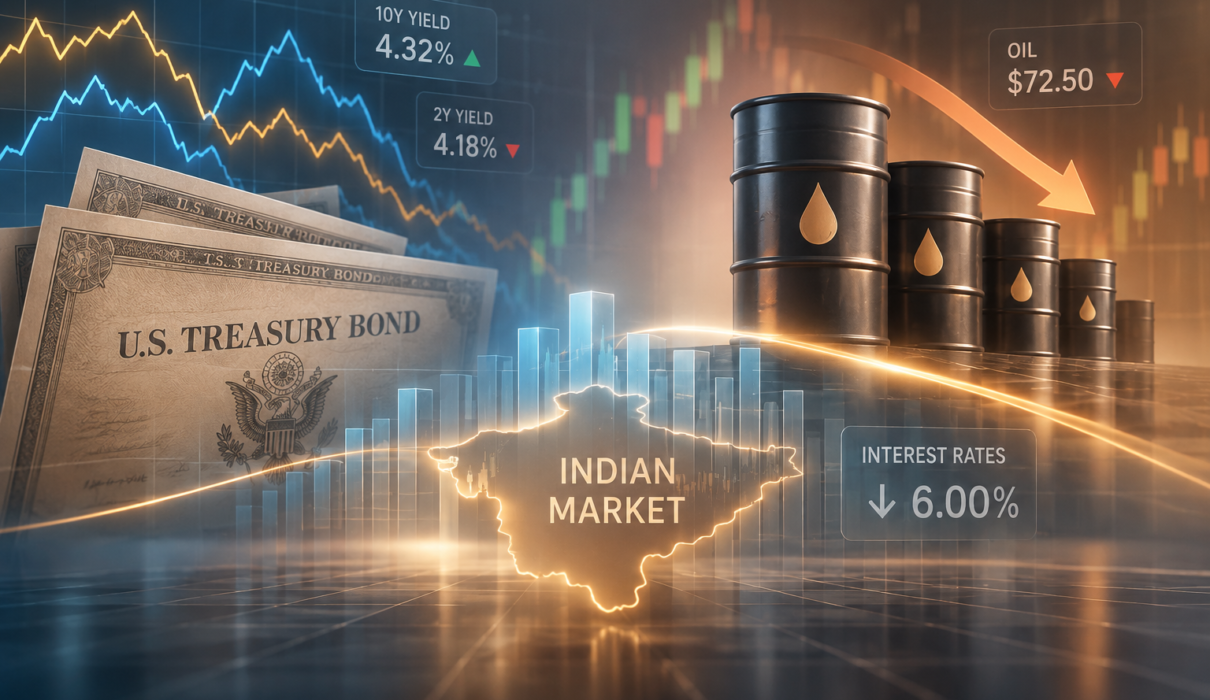
Rising US Treasury yields and falling oil prices can pull Indian markets in opposite directions. Higher US yields can make dollar assets more attractive, while cheaper crude can reduce inflation pressure for an oil-importing economy like India. For households, the impact may appear through loan rates, fuel-linked expenses, rupee movement, SIP behaviour, and day-to-day budgeting.
US Treasury yields act as a global benchmark for the cost of money. When they rise, investors compare emerging-market assets with relatively safer US government bonds. At the same time, lower crude oil prices can support India’s inflation outlook because India imports a large share of its energy needs.
Why US Treasury Yields Matter for Indian Investments
A Treasury yield is the return investors demand for lending money to the US government. When that return rises, global investors may prefer US bonds over riskier assets, including emerging-market equities and debt. This can influence foreign portfolio flows, the rupee, Indian bond yields, and equity market sentiment.
Higher US yields can also raise the cost of money across the world. Companies with foreign borrowing may face higher interest expenses, and equity valuations can come under pressure when safer yields look more attractive. A CNBC report on the relationship between oil and Treasury yields explains that these links can affect multiple asset classes at the same time.
Why are US Treasury Yields Rising?
US Treasury yields usually rise when investors expect higher inflation, tighter monetary policy, or heavier government borrowing. They can also move higher when markets demand extra compensation for lending over longer periods. These changes matter because US yields influence global capital allocation, not only American financial markets.
For Indian investors, the immediate issue is not the US bond market alone. The key question is how global investors react to the new yield level compared with returns available in India. If dollar assets become more attractive, foreign flows into Indian equities and debt can become more volatile.
How Higher US Yields Affect the Rupee and Capital Flows
When US yields rise, the dollar can strengthen if investors move money toward US assets. A stronger dollar can put depreciation pressure on the rupee, especially when foreign investors reduce exposure to emerging markets. A weaker rupee can make imports costlier, which matters for India because crude oil and several industrial inputs are imported.
Foreign portfolio investments can move quickly during such periods. Equity markets may see sharper daily swings, and bond yields may adjust if investors demand higher returns for holding Indian debt. Investors can follow official policy communication through the RBI website and exchange-related updates through the NSE.
Why Falling Oil Prices Matter for India
Oil prices can fall because of higher supply, weaker demand, slower global growth expectations, or changes in inventories. Traders also react to geopolitics, currency moves, and policy signals from major oil-producing countries. For India, lower oil prices are generally helpful because they can reduce import pressure and ease inflation expectations.
Cheaper crude can reduce costs linked to transport, logistics, packaging, aviation, and some manufacturing inputs. The benefit is not always immediate for consumers because retail fuel prices also depend on taxes, margins, and local policy choices. Still, markets often start pricing lower inflation risk before households see a clear change in monthly expenses.
Impact on Inflation and Household Spending
Lower crude oil prices can reduce cost-push inflation in the economy. The Michigan Journal of Economics explains that oil prices affect portfolios through inflation and interest-rate channels, because higher energy costs can force companies to raise prices. When oil gets cheaper, some of that pressure can ease for energy-linked businesses and consumers.
For households, the effect may show up through transport costs, delivery charges, travel expenses, and prices of goods that depend on logistics. The pass-through can be uneven because petrol and diesel prices include taxes and distribution costs. Families should treat lower oil as a possible budget relief, not as a reason to increase unnecessary spending.
Impact on the Fiscal Position
Lower oil prices can reduce India’s import bill and ease pressure on the current account. They may also reduce subsidy pressure in areas linked to fuel and energy use. This can give the government more flexibility, although the final fiscal impact depends on taxes, spending choices, and revenue trends.
Cheaper oil does not automatically mean that every consumer will pay much less at the pump. Retail prices are shaped by crude costs, refining margins, taxes, marketing margins, and government policy. Investors should therefore separate the macroeconomic benefit from the retail price they see in their city.
Impact on Indian Bonds, Equities, and the Economy
Indian financial markets react to both global and domestic signals. Rising US yields can create pressure by pulling money toward dollar assets, while falling oil prices can provide relief by improving the inflation outlook. This is why Indian government bonds may sometimes remain stable even when global yields are moving higher.
Debt investors usually watch inflation, liquidity, RBI communication, and government borrowing. Equity investors watch earnings, foreign flows, the rupee, crude prices, and global risk appetite. Households should avoid reacting to one headline in isolation because the final effect depends on how these factors combine.
Effect on Indian Bond Markets
When yields rise, existing bond prices can fall because new bonds may offer better returns. This relationship is important for anyone investing in debt funds, bonds, or long-duration fixed-income products. Longer-duration instruments usually react more sharply to yield changes than shorter-duration instruments.
Rising US yields can put upward pressure on Indian yields if global investors demand more compensation for holding emerging-market debt. Falling oil prices can work in the other direction by easing inflation expectations and improving macro sentiment. Investors should understand duration risk and consult a SEBI-registered investment adviser before making major changes.
Effect on Indian Equity Markets
Higher yields can reduce the relative appeal of equities because investors have more alternatives in fixed income. They can also raise financing costs for businesses, especially companies that depend heavily on borrowing. Growth-oriented businesses can be sensitive to higher rates because their valuations often depend on earnings expected far in the future.
Lower oil prices may support consumer-focused and cost-sensitive sectors by reducing input and transport pressure. However, this does not make any sector or company automatically attractive for every investor. Sector trends are useful for understanding risk, but personal investment decisions should be made with a SEBI-registered investment adviser.
Sectoral Implications in the Indian Market
Different sectors respond differently to changes in oil prices and global yields. Energy-linked businesses may face margin and inventory changes when crude prices decline. Consumer, logistics, aviation, manufacturing, and industrial businesses may experience cost relief, depending on pricing power and demand conditions.
Interest-sensitive sectors can still face pressure if borrowing costs stay elevated. Real estate, infrastructure, capital goods, and highly leveraged businesses may be affected when funding becomes expensive. Investors should use sector information as context and avoid treating it as a buy, sell, or hold signal.
Energy and Oil-Linked Businesses
Oil producers, refiners, marketers, and energy-linked companies do not all respond to crude prices in the same way. Some may benefit from lower input costs, while others may face pressure on revenue or inventory values. The outcome depends on business models, pricing rules, taxes, and policy settings.
Indian investors should avoid making security-specific decisions only because oil moved in one direction. A falling crude price can improve the broader inflation picture without benefiting every company equally. For household energy context, you can read this PocketPlanGuru explainer on electricity bills and power-sector developments.
Consumer and Industrial Sectors
Consumer-focused sectors may benefit when inflation cools and households feel less stretched. Lower transport and packaging costs can support margins or prices if companies pass on the benefit. Demand still depends on wages, employment, credit conditions, and consumer confidence.
Industrial and infrastructure sectors face a more mixed picture. Lower oil can reduce operating costs, but higher global yields can make funding more expensive. Readers can understand this link better through this PocketPlanGuru explainer on RBI liquidity and loan conditions.
Influence on Indian Interest Rates and RBI Policy
The RBI tracks inflation, growth, liquidity, currency stability, and global financial conditions. Falling oil prices can give the central bank more comfort on inflation, while rising US yields can complicate currency and capital-flow management. Policy decisions therefore depend on the full macro picture, not only one commodity or one foreign bond yield.
The repo rate remains a key signal for loans and deposits in India. If inflation eases because oil prices remain lower, borrowing conditions may eventually become more comfortable. If global yields rise sharply and pressure the rupee, the RBI may still choose a cautious approach.
Transmission to Home Loans and Personal Loans
Global rate changes can affect India through currency pressure, capital flows, and funding costs. Banks and companies that raise foreign debt may face costlier financing when global yields rise. Domestic bond yields may also move if investors demand higher compensation for inflation or currency risk.
Home loan borrowers should watch floating rates and reset dates carefully. New borrowers should compare the total cost of borrowing, not only the advertised interest rate. Existing borrowers should review EMI affordability, emergency savings, and insurance cover before adding fresh debt.
RBI’s Approach amid Changing Global Conditions
RBI policy usually tries to balance inflation control with growth support. Lower oil prices can help the inflation side of that balance by reducing pressure on fuel-linked costs. Higher US yields can create challenges by influencing the rupee, foreign flows, and domestic liquidity.
Investors should rely on official RBI statements rather than market rumours or social media claims. SEBI also cautions investors against unregistered advice and misleading promises. Investor education material is available on the SEBI website, and personal investment decisions should be discussed with a SEBI-registered investment adviser.
How These Trends Affect Households and Retail Investors
For households, the most visible effect may come through loans and monthly expenses. A home loan, car loan, or personal loan can become costlier if interest rates remain elevated. Credit card debt is especially risky because it already carries high interest, even before broader rates move higher.
Lower oil prices can provide some relief through fuel-linked costs and transport expenses. The benefit may be slow and uneven because local taxes, pricing policies, and business margins affect final prices. Families should use any savings to strengthen financial stability rather than make impulsive investment decisions.
What Borrowers Should Watch
Borrowers should calculate whether their EMI remains comfortable if rates rise or income falls. This stress test is useful for floating-rate home loans and for households with multiple debts. A healthy emergency fund can prevent short-term market stress from becoming a personal financial crisis.
Personal loan and credit card users should be extra careful during periods of high rates. These debts can weaken household cash flow quickly if repayment is delayed. Before taking any new loan, compare tenure, processing charges, foreclosure rules, and total interest cost.
What Savers and Long-Term Investors Should Watch
Savers should understand that rising yields can improve returns on new fixed-income investments over time. However, existing bond prices can fall when yields rise, especially for longer-duration products. This is why fixed-income choices should match the investor’s time horizon and risk comfort.
Long-term investors should avoid stopping SIPs only because yields or oil prices moved during the week. Asset allocation should be based on goals, time frame, income stability, and risk capacity. For deeper fixed-income lessons, read this PocketPlanGuru explainer on debt-instrument risk and investor protection.
Practical Steps for Indian Investors
Start by reviewing your asset allocation instead of reacting to headlines. Check whether your portfolio depends too heavily on one theme, one sector, or one interest-rate view. A diversified plan can reduce the emotional pressure created by global market swings.
Review your loan burden, emergency fund, insurance cover, and tax planning together. Long-term products such as EPF, PPF, NPS, deposits, and tax-saving options under Section 80C should be evaluated according to goals and rules. Income tax and ITR planning should not depend only on market news about oil or US yields.
Managing Interest Rate and Inflation Risks
Fixed-income investors should understand duration risk before choosing debt products. When yields rise, existing bond prices can fall, and the fall can be sharper for longer-duration holdings. Shorter-duration choices may behave differently, but they also come with their own return and reinvestment considerations.
Inflation risk matters because household goals become costlier over time. Lower oil prices can ease inflation temporarily, but education, healthcare, rent, and lifestyle costs may still rise. A financial plan should account for both short-term relief and long-term cost growth.
Staying Grounded During Market Noise
Use simple rules to stay disciplined during volatile periods. Keep an emergency fund before increasing market exposure, and avoid borrowing to invest. Maintain adequate term insurance if dependants rely on your income.
Do not follow social media tips that promise quick gains from oil, currency, or yield movements. Market headlines can help you understand the environment, but they cannot replace personal financial planning. For tailored decisions, consult a SEBI-registered investment adviser.
FAQs: US Yields, Oil Prices, and Your Investments
These questions address common concerns for Indian retail investors. The answers explain broad links between global rates, crude prices, markets, and household finances. They do not recommend any specific stock, fund, ETF, or market-timing move.
How do rising US Treasury yields affect the Indian rupee?
Rising US Treasury yields can make dollar assets more attractive to global investors. If money moves toward US assets, emerging-market currencies such as the rupee can face pressure. A weaker rupee can raise import costs, especially for crude oil and other dollar-priced goods.
Will falling oil prices always benefit Indian consumers?
Falling oil prices generally help India because the country imports a large share of its crude oil needs. They can reduce fuel-related inflation and ease transport-linked costs over time. Consumers may not see the full benefit immediately because taxes, pricing policy, and company margins affect final retail prices.
Should I change my investment mix because of these trends?
Do not make sudden changes only because of one market event. Review your goals, asset allocation, debt levels, time horizon, and emergency fund before changing your plan. For personal investment decisions, consult a SEBI-registered investment adviser.
How does the RBI respond to external pressures?
The RBI tracks inflation, growth, liquidity, currency stability, and global financial conditions. Falling oil prices may ease inflation pressure, while higher US yields may tighten global conditions. RBI can use policy rates, liquidity tools, and communication to manage risks that affect loan rates and bond yields.
Can lower oil prices reduce India’s fiscal deficit?
Lower oil prices can help reduce India’s import bill and may lower subsidy pressure in some areas. This can improve fiscal flexibility if other spending and revenue conditions remain supportive. The final impact depends on government policy, tax collections, and broader economic conditions.
Final Takeaway for Indian Investors
Rising US Treasury yields and falling oil prices affect Indian investments through currency movement, borrowing costs, inflation expectations, and sector sentiment. Higher US yields can create pressure on equities, bonds, and the rupee, while lower oil prices can support inflation control and household budgets. The two forces can offset each other, which is why markets may not always react in a simple direction.
The best response is to understand the pressure points without making rushed decisions. Keep your goals, EMIs, insurance, emergency fund, and tax planning in one clear view. Stay informed through credible sources, avoid unregistered advice, and consult a SEBI-registered investment adviser for personalised guidance.
Disclaimer: The information above is for educational purposes only and does not constitute financial advice.